
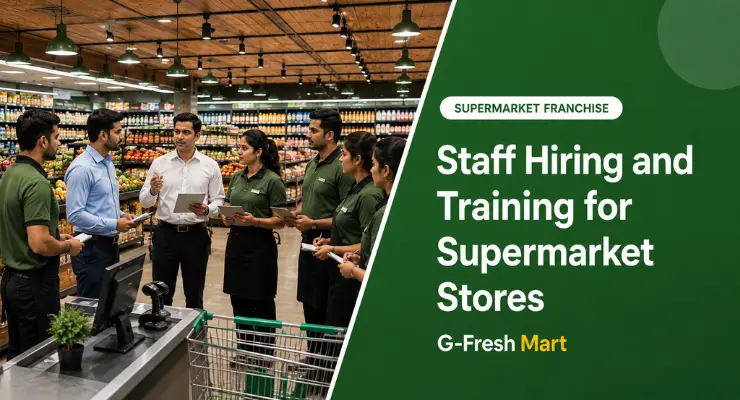

Quick Answer
Staff hiring and training for supermarket stores works best as a structured process covering four stages: recruitment (finding and screening the right candidates), selection (interviews and skills evaluation), onboarding (a clear first 90 days), and ongoing training (keeping staff sharp and engaged over time). Getting this right matters directly to the bottom line, since well-trained, engaged staff reduce turnover, cut billing errors, and improve customer experience, which is what ultimately drives repeat visits. For a G-Fresh Mart franchise owner, much of this process is already built into the franchise system, with hiring support during setup and lifetime billing software training included for every staff member.
Introduction
A supermarket runs on its people. The best location, the widest product range, and the cleanest store design still depend on staff who can bill accurately, keep shelves stocked, and treat customers well.
Staff hiring and training is not an administrative task to get through quickly. It is one of the decisions that most directly determines whether a store performs well or struggles.
Getting staff hiring and training right early pays off in ways that compound over time.
Employees who are hired carefully and trained properly stay longer, make fewer costly mistakes, and build the kind of customer relationships that bring people back week after week.
Getting it wrong creates a cycle of constant rehiring, inconsistent service, and avoidable losses at the billing counter.
This guide walks through a complete staff hiring and training process for a supermarket store, covering recruitment, selection, onboarding, ongoing development, and employee engagement, with specific attention to how a G-Fresh Mart franchise owner can use the brand’s own support system alongside these practices.
It is worth being clear from the outset that staff hiring and training is rarely a one-time project that gets finished and forgotten.
The strongest supermarket teams are built through a continuous cycle of careful hiring, structured onboarding, ongoing skill development, and genuine engagement, repeated consistently over the life of the store, not treated as a checklist to complete once and move past.
Also Read: Problems in Supermarket Business: 10 Causes and Solutions
Why Staff Hiring and Training Matters So Much in Grocery Retail
A supermarket is a people-facing business at every touchpoint. Staff are the ones handling billing accuracy, stock rotation, customer complaints, and the daily impression a store makes on the people walking through it.
Poor hiring decisions and thin training show up quickly, in longer queues, wrong change given at the counter, empty shelves nobody noticed, and customers who quietly decide to shop elsewhere next time.
Good staff hiring and training, by contrast, builds a store that runs smoothly even when the owner is not standing at the counter.
Employees who feel properly trained and genuinely valued are significantly more likely to stay, which reduces the cost and disruption of constant rehiring and keeps service quality consistent for regular customers who come to recognise and trust the same familiar faces.
Step 1: Recruitment Strategies That Actually Work
Recruitment is the first and arguably most important stage of staff hiring and training, since every later stage depends on starting with the right candidates.
- Application review: Go through every application against the specific requirements stated in your job posting, rather than hiring the first reasonably qualified person who applies. A few extra days spent reviewing candidates properly saves months of correcting a poor hiring decision.
- Competence testing: For roles involving billing or stock handling, a short practical test, such as a basic maths check for a cashier role, tells you far more about real capability than a resume alone.
- Structured interviews: Prepare a consistent set of questions built around the specific skills each role requires, so you can fairly compare candidates rather than relying on an unstructured conversation that varies from one interview to the next.
- Work samples or trial shifts: Where practical, a short paid trial shift on the floor reveals far more about how a candidate handles real customers and real pressure than any interview question can.
- Group scenarios: For larger hiring rounds, presenting candidates with realistic store scenarios, such as handling a stock shortage or a dissatisfied customer, shows how they think and react under the kind of pressure the job actually involves.
- Reference checks: A quick call to a previous employer or supervisor is one of the simplest, most reliable ways to confirm what a candidate has told you about their past performance and reliability.
Step 2: The Selection Process
Once applications start coming in, a consistent selection process helps you move from a long list of candidates to the right hire without missing anyone genuinely strong.
Start by posting the role clearly, either through local job portals or through simple word of mouth in the neighbourhood, with a job description that states the specific skills required and the responsibilities involved, so candidates self-select appropriately before they even apply.
Next, run an initial screening to shortlist candidates who genuinely meet the requirements, followed by a first interview, either by phone or in person depending on the role.
For additional insights into supermarket business operations and franchise opportunities, you can also explore supermarket business resources.
This narrows the list to a manageable group of serious candidates before you invest time in deeper evaluation.
The final stage is a proper skills evaluation. For a billing role, this means testing numerical accuracy and comfort with a point of sale system.
For a customer-facing floor role, this means presenting a realistic scenario, such as a customer requesting a refund outside policy, and observing how the candidate handles the tension between customer satisfaction and following store rules.
A candidate who can stay calm, polite, and firm in that moment is showing you exactly the skill the job requires every single day.
Step 3: Onboarding New Staff Properly
A strong onboarding process is one of the highest-return investments a supermarket owner can make, directly improving retention, job satisfaction, and how quickly a new hire becomes genuinely productive.
| Stage | What to Do |
| Preparation and welcome | Have their workstation, uniform, and system access ready before day one. Send a short welcome message covering what to expect and what to bring |
| Introduction and orientation | Give a warm, personal welcome on the first day, introduce them to the team, and walk through the store’s basic policies and expectations |
| Skills training | Provide hands-on training on the billing system, stock handling, and customer service standards, ideally paired with a more experienced colleague for the first few shifts |
| Clear goals | Set specific, achievable expectations for the first 30, 60, and 90 days, so the new hire knows exactly what success looks like at each stage |
| Regular check-ins | Schedule short, informal conversations in the early weeks to answer questions and catch any confusion before it becomes a habit |
| 30-60-90 day review | Formally review progress at each milestone, confirming what is going well and adjusting training where gaps appear |
A new hire who goes through a structured onboarding like this reaches full confidence and productivity noticeably faster than one who is simply shown the billing counter and left to figure things out.
The early weeks set the tone for how long that employee stays and how well they perform.
Step 4: Ongoing Training and Development
Staff hiring and training does not end once onboarding is complete. The best-performing supermarket teams keep learning and improving continuously, not just during their first few weeks.
- Target the right hires from the start: Look for candidates who bring some retail experience or a genuinely strong customer service attitude, and who show real willingness to grow within the role, since this openness to learning matters as much as existing skill.
- Keep the initial training interactive: A structured programme covering core tasks, customer service procedures, and safety rules works best when it mixes hands-on practice with short, simple e-learning content, since different people absorb information differently.
- Run regular refreshers: Short workshops or brief training sessions, even 15 to 20 minutes during a quieter period, keep staff sharp on customer service standards and any new store procedures or seasonal promotions.
- Rotate staff across roles: Cross-training a cashier on floor duties, or a floor staff member on billing, builds a more flexible team that can cover for absences without disrupting the store, while also keeping the work more varied and engaging for staff themselves.
Step 5: Employee Engagement and Recognition
Staff who feel genuinely valued do better work and stay longer, which makes engagement and recognition a practical business tool rather than simply a nice gesture.
Involve staff in small decisions where reasonable, such as asking for their input on a display change or a new product placement, and acknowledge good work specifically and promptly rather than only during a formal review.
A brief, genuine word of appreciation after a busy shift handled well often matters more to staff morale than any formal programme.
Regular, honest feedback conversations, where staff also feel comfortable raising their own concerns, build the kind of trust that keeps good employees from looking elsewhere.
A supermarket team that feels heard and appreciated consistently delivers better customer service than one that does not, and that difference shows up directly in repeat customer visits and word of mouth.
Common Mistakes in Supermarkets Staff Hiring and Training
Certain mistakes show up repeatedly in how supermarket owners approach staff hiring and training, and recognising them early makes them far easier to avoid.
- Hiring under pressure: Filling a vacancy quickly because the store is short-staffed often leads to a rushed decision that costs more in the long run through retraining or replacing a poor fit. Where possible, keep a small pipeline of pre-screened candidates so an urgent vacancy does not force a compromise.
- Skipping structured training for experienced hires: An experienced candidate still needs to learn your specific store’s systems, layout, and customer base. Assuming prior experience means they need no onboarding at all is a common and costly shortcut.
- Treating training as a one-time event: A single induction session covers the basics but does not build lasting competence or engagement. Ongoing refreshers and check-ins matter as much as the initial training itself.
- Not tracking what is actually working: Without reviewing turnover, billing accuracy, or customer feedback linked to specific staff, it becomes difficult to know which parts of your hiring and training approach are genuinely effective and which need to change.
How G-Fresh Mart Supports Staff Hiring and Training
For a G-Fresh Mart franchise owner, a meaningful part of the staff hiring and training process described in this guide is already built into the franchise system, rather than something to design entirely from scratch.
| Support Provided | What It Covers |
| Hiring guidance during setup | Support with role requirements and the local hiring process during the 45-day store setup period |
| Structured initial training | A training programme covering billing procedures, stock rotation, and customer service standards, delivered as part of onboarding |
| Lifetime billing software training | Every new hire, at any point during the franchise term, can be trained on the POS system at no additional cost |
| Operational reference materials | Standard procedures for daily reconciliation and customer service that new staff can be trained against consistently |
This support does not remove the need for a franchise owner to hire thoughtfully and manage their team well day to day.
What it does is remove much of the groundwork, since the training curriculum, the billing system, and the operational standards are already built and proven, rather than something a new owner has to create alone.
Check out this: How to Write a Supermarket Business Plan: A Step-by-Step Guide
Bringing It All Together
Staff hiring and training for supermarket stores works best as a connected process, not a series of separate tasks. Careful recruitment finds the right people.
A structured selection process confirms they can actually do the job. Proper onboarding sets them up to succeed from day one.
Ongoing training keeps them sharp and growing. Genuine engagement keeps them wanting to stay.
Supermarkets that treat staff hiring and training as a genuine priority, not an afterthought squeezed in around daily operations, consistently build stronger, more stable teams.
That stability shows up directly in customer experience, in fewer billing errors, and in the kind of steady repeat business that makes a neighbourhood grocery store genuinely profitable over time.
The investment of time in getting staff hiring and training right rarely feels urgent in the moment, particularly for a first-time store owner focused on opening day logistics.
But every experienced retail operator eventually recognises that the quality of a store’s team, more than almost any other single factor, determines whether daily operations run smoothly or constantly demand the owner’s direct attention.
Building that team well from the start is time that pays for itself many times over across the life of the store.
G-Fresh Mart franchise owners get hiring support and a structured training programme built into the 45-day setup process, along with lifetime billing software training for every staff member. Apply for a free franchise consultation at or calculate your investment. A franchise advisor responds within 2 business days.
Frequently Asked Questions
What are the key steps in staff hiring and training for supermarket stores?
The key steps are recruitment (finding and screening candidates through application review, competence tests, and structured interviews), selection (interviews and skills evaluation), onboarding (a structured first 90 days including orientation, hands-on training, and clear goals), and ongoing training (regular refreshers, cross-training, and continuous development to keep staff sharp and engaged over time).
How long should onboarding take for new supermarket staff?
A structured onboarding process typically runs across the first 90 days, with clear checkpoints at 30, 60, and 90 days to review progress. The first week should cover orientation and initial hands-on training, while the following weeks focus on building confidence and independence, with regular short check-ins to catch and resolve any confusion early.
What is the most important skill to test when hiring supermarket staff?
For billing and cashier roles, numerical accuracy and comfort with a point of sale system are essential and worth testing directly through a short practical exercise. For customer-facing floor roles, the ability to stay calm, polite, and firm when handling a difficult situation, such as a customer complaint, matters more than any single technical skill and is best assessed through a realistic scenario during the interview.
How can a supermarket reduce staff turnover?
Staff turnover is reduced primarily through a genuinely strong onboarding process, ongoing training that keeps the role interesting rather than repetitive, fair pay relative to the local market, and consistent recognition of good work. Employees who feel properly trained and genuinely valued are significantly more likely to stay, which directly reduces the cost and disruption of constant rehiring.
What staff hiring and training support does G-Fresh Mart provide to franchise owners?
G-Fresh Mart provides hiring guidance during the 45-day setup process, a structured initial training programme covering billing, stock rotation, and customer service standards, and lifetime billing software training for every staff member at any point during the franchise term. This significantly reduces the groundwork a new franchise owner needs to build independently, since the training curriculum and systems are already established and proven across the network.