

Quick Answer
Before opening a supermarket franchise store, there are 7 things worth understanding clearly: the true total investment goes well beyond the franchise fee, a franchise gives you a proven system rather than just a brand name, your location sets the ceiling on how well the store can ever perform, you still need your own specific business plan even within a franchise system, legal compliance is non-negotiable and takes real time, marketing is a shared responsibility between you and the franchisor, and daily staffing and operations remain entirely yours to manage well. Understanding these 7 things clearly before signing an agreement leads to a far more realistic and successful start.
Introduction
Opening a supermarket franchise store is one of the most accessible ways to enter organised retail in India, but going in with only a general sense of what it involves leads to avoidable surprises later.
Grocery retail is growing steadily, and the appeal of a proven brand and support system is real, but a supermarket franchise store still requires specific preparation, realistic expectations, and active daily management to succeed.
This guide covers 7 specific things worth knowing before you commit to opening a supermarket franchise store, drawn from how the process actually works for a G-Fresh Mart franchise owner from first enquiry through to daily operations.
Each of the 7 things below addresses a specific area where first-time applicants commonly hold an incomplete or overly optimistic picture.
None of them are meant to discourage the decision to open a supermarket franchise store.
They are meant to replace assumptions with a clearer, more accurate understanding before any money changes hands.
Also read: G-Fresh Mart Supermarket Franchise: Your Complete Guide
Thing 1: The Real Investment Goes Well Beyond the Franchise Fee
Many first-time applicants focus on the franchise fee as though it represents the total cost of opening a supermarket franchise store.
In reality, the fee is usually the smallest of several components.
A complete investment includes the franchise fee, billing software, a security deposit, interior fit-out, initial stock, and working capital to cover the first few months of operation before the store reaches consistent profitability.
Understanding the full figure before you apply prevents the common and costly mistake of being under-capitalised in the first 90 days, which is exactly when a new store needs the most financial breathing room.
It also protects against the scenario where an applicant secures funding for the franchise fee alone, only to discover mid-setup that fit-out and stock costs require significantly more capital than expected.
At G-Fresh Mart: For a G-Fresh Mart Mini Mart, the franchise fee is Rs 2,10,000 plus GST, but the complete investment for a fully operational store, including fit-out, stock, and working capital, typically runs Rs 14 to 25 lakh. Getting this full figure from your franchise advisor early avoids any surprises later in the process.
Thing 2: A Franchise Gives You a System, Not Just a Name
The value of a supermarket franchise store is not the brand name above the door.
It is the operational system behind it: the supplier relationships, the technology, the training, and the standards that have already been tested and refined across many other locations.
A franchisee who treats the brand as decoration rather than using the system underneath it is leaving most of the value of the franchise unused.
This system typically includes centralised procurement giving better pricing than an individual store could negotiate alone, a pre-built technology platform for billing and inventory, and a training programme that shortens the learning curve for someone new to retail.
At G-Fresh Mart: G-Fresh Mart’s system includes 1,500 plus brand partnerships for procurement, a cloud POS system with inventory alerts, and a structured 45-day setup process that trains new owners and their staff before opening day, not after.
Thing 3: Location Sets the Ceiling on Performance
No amount of good management can fully compensate for a poor location.
A supermarket franchise store depends on genuine local demand, and this means household density, income levels, and existing competition in the immediate area matter more than almost any other single decision made before opening.
A location that seems convenient because it is close to the owner’s own home is not automatically the right commercial choice.
A proper assessment of catchment population, nearby competition, and commercial zoning should happen before any lease is signed, not after.
At G-Fresh Mart: G-Fresh Mart conducts a formal site survey before approving any franchise location, assessing catchment population, household income profile, competition proximity, and zoning at no additional cost to the applicant. This step exists specifically to prevent an otherwise well-run supermarket franchise store from underperforming simply because of where it was placed.
Thing 4: You Still Need Your Own Business Plan
A franchise system provides the product range, supply chain, and operating standards, but it does not remove the need for a franchisee to think through their own specific numbers, timeline, and management approach.
A supermarket franchise store is still your business, run in your specific location, with your specific capital and staff.
A short but honest business plan covering your investment figures, your monthly cost estimate, your break-even target, and how you personally plan to manage the store day to day is worth writing even though the franchisor has already solved most of the harder strategic questions for you.
At G-Fresh Mart: Because G-Fresh Mart already defines the product range, supply chain, and operational system, a franchise applicant’s business plan can focus mainly on their specific location and financial figures rather than researching an entire market from scratch, which significantly shortens the planning process.
Thing 5: Legal Compliance Takes Real Time and Cannot Be Skipped
Every supermarket franchise store in India requires several specific registrations and licences before it can legally open, and underestimating how long these take is one of the most common causes of a delayed opening. This is not a franchise-specific requirement.
It applies equally to any grocery retail business, franchised or independent.
The core requirements typically include GST registration, an FSSAI food safety licence, a trade licence from the local municipal authority, and registration under the Shops and Establishments Act.
Each has its own processing time, and applying for them in parallel rather than one after another saves meaningful time.
At G-Fresh Mart: G-Fresh Mart’s franchise onboarding process includes guidance on this compliance checklist, along with 3 months of free accounting support after opening to help new owners manage GST filing and reconciliation correctly from the very first month.
Thing 6: Marketing Is a Shared Responsibility, Not Something You Can Ignore
A common misconception is that joining an established brand means marketing takes care of itself.
In reality, brand-level marketing builds general awareness, but it is local marketing, specific to your neighbourhood and your store, that actually drives footfall and repeat visits for your particular supermarket franchise store.
Simple, low-cost local marketing habits, such as an active Google Business Profile and a WhatsApp broadcast list for regular customers, consistently outperform passive reliance on brand recognition alone, especially in the first 6 months when the store’s local customer base is still forming.
At G-Fresh Mart: G-Fresh Mart provides brand-level digital marketing, social media promotion of new store openings, and a managed store locator listing, while individual franchise owners are expected to run their own local marketing activity to build a loyal neighbourhood customer base around their specific store.
Thing 7: Daily Staffing and Operations Remain Entirely Yours
A franchisor can provide training, systems, and standards, but they cannot run your store for you.
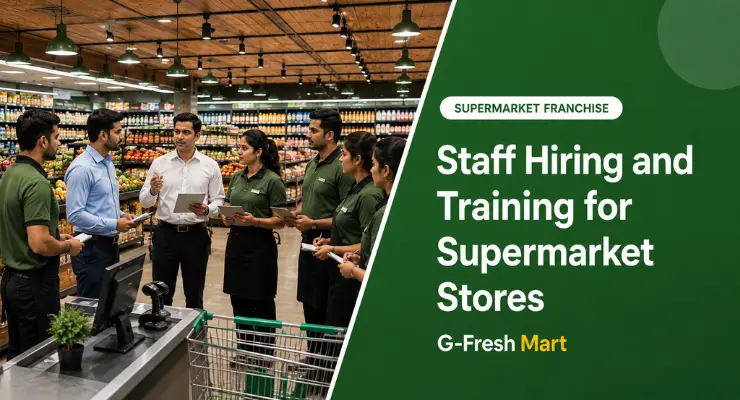
Hiring the right staff, training them properly, managing daily stock rotation, and maintaining consistent customer service are all responsibilities that sit with the franchise owner every single day the store is open.
The quality of daily execution is what ultimately separates a supermarket franchise store that thrives from one that merely survives, even when both are operating under the exact same brand, with access to the exact same system and support.
At G-Fresh Mart: G-Fresh Mart provides hiring support and a structured training programme during the 45-day setup, along with lifetime billing software training for every staff member throughout the franchise term, but the daily discipline of using these tools consistently is the responsibility of the franchise owner.
The 7 Things at a Glance
| S.NO | Thing to Know | Why It Matters |
| 1 | Real investment goes beyond the franchise fee | Prevents being under-capitalised in the critical first 90 days |
| 2 | A franchise gives you a system, not just a name | The supply chain and technology are the real value, not the brand alone |
| 3 | Location sets the ceiling on performance | No management skill fully compensates for a poor location choice |
| 4 | You still need your own business plan | Your specific numbers and timeline are yours to define, not the franchisor’s |
| 5 | Legal compliance takes real time | Delays here are one of the most common causes of a late opening |
| 6 | Marketing is a shared responsibility | Local marketing drives footfall; brand awareness alone does not |
| 7 | Daily operations remain entirely yours | Execution quality separates a thriving store from one that merely survives |
Check out this: How to Write a Supermarket Business Plan: A Step-by-Step Guide
Putting These 7 Things Into Practice
None of these 7 things are meant to discourage someone considering a supermarket franchise store.
Grocery retail remains one of the most structurally sound business categories available to Indian investors, precisely because demand is steady and the organised sector is still growing quickly across Tier 2 and Tier 3 cities.
What these 7 things do is set realistic expectations, so a new franchise owner enters the process with clear eyes rather than assuming a brand name alone guarantees success.
A supermarket franchise store that succeeds is almost always one where the owner understood the full investment upfront, genuinely used the franchisor’s system rather than treating it as a formality, chose their location carefully, planned their own specific numbers, handled compliance on time, took local marketing seriously, and showed up daily to manage the store well.
Every one of these is within a franchise owner’s control.
It is worth returning to these 7 things periodically even after opening, not just before signing an agreement.
A franchise owner six months into operation who revisits their original assumptions about investment, location performance, marketing effort, and daily operations will often find one or two areas where the initial plan needs adjusting.
Treating this list as a one-time checklist rather than a recurring reference is a missed opportunity to keep improving how the store is run.
To understand exactly what these 7 things look like for a G-Fresh Mart franchise in your city, apply for a free consultation at or calculate your investment. A franchise advisor responds within 2 business days.
Frequently Asked Questions
What is the most important thing to know before opening a supermarket franchise store?
The most important thing is that the real investment goes well beyond the franchise fee. A complete budget includes the fee, billing software, security deposit, interior fit-out, initial stock, and several months of working capital. Underestimating this total is one of the most common and costly mistakes first-time franchise owners make.
Does a supermarket franchise guarantee success?
No. A franchise provides a proven system, brand recognition, and support, but daily execution, including staffing, stock management, and local marketing, remains entirely the responsibility of the franchise owner. Two stores from the same brand can perform very differently depending on location and how well the owner runs daily operations.
How important is location when opening a supermarket franchise store?
Location is one of the most important factors, since no amount of good management fully compensates for a poor location. Household density, nearby competition, and commercial zoning should all be properly assessed before signing a lease. G-Fresh Mart conducts a formal site survey covering these factors before approving any new franchise location.
Do I need my own business plan if I am opening a franchise?
Yes, though it is a shorter and more focused document than what an independent business would need. Since the franchisor already defines the product range, supply chain, and operating system, a franchise applicant’s business plan mainly needs to cover their specific location, investment figures, and how they plan to manage the store personally.
What support does G-Fresh Mart provide to a new supermarket franchise store?
G-Fresh Mart provides a 45-day structured setup, a cloud POS system with lifetime staff training, 1,500+ brand partnerships for procurement, a formal site survey before location approval, hiring and training support, 3 months of free accounting assistance, and brand-level digital marketing including a managed store locator listing.