
Quick Answer
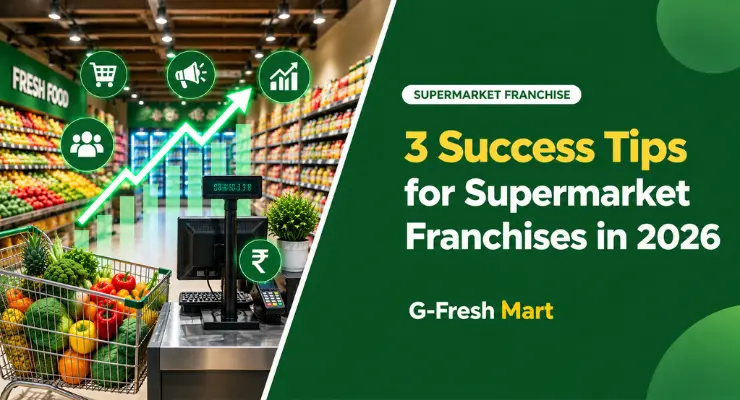
The 3 most important tips for supermarket franchise success in 2026 are: build genuine sustainability into daily operations rather than treating it as a marketing slogan, use the technology already available in the franchise system consistently rather than letting it sit unused, and prioritise real community engagement over transactional customer service. None of these require a large additional budget for a G-Fresh Mart franchise owner, since the tools and systems needed are already part of the standard franchise package. What they require is consistent daily follow-through.
Introduction
The grocery retail landscape keeps shifting, and supermarket franchise owners who assume that yesterday’s approach will keep working tend to fall behind quietly rather than dramatically. Consumer expectations around sustainability have risen.
Technology that used to be optional is now a genuine competitive factor even at the neighbourhood store level. And the brands that build real community relationships consistently outperform those that treat customers as one-time transactions.
This guide covers 3 tips for supermarket franchise success in 2026 that matter specifically for a G-Fresh Mart franchise owner, with practical detail on what each one actually looks like day to day, not just the general principle behind it.
It is worth noting upfront that these are deliberately not the only 3 things that matter in running a supermarket franchise well.
Location, inventory management, and staffing all matter enormously, and are covered in depth elsewhere.
These particular 3 tips are highlighted here because they represent the areas where market conditions have shifted most significantly in recent years, and where a franchise owner who has not updated their approach since opening is most likely to be falling behind without fully realising it.
Also read: How to Increase Sales at Your Supermarket in 2026
Tip 1: Build Sustainability Into Daily Operations, Not Just Marketing
Consumers have grown noticeably more conscious of where their money goes, particularly around food quality, sourcing, and how a business treats the environment.
This shift is not limited to premium urban shoppers. It has spread across income levels and city tiers, and it shows up in small but consistent purchase decisions rather than in dramatic statements.
A customer choosing between two otherwise similar stores increasingly factors in which one feels cleaner, more responsible, and more attentive to waste.
For a supermarket franchise, the most effective response is practical rather than promotional.
A near-expiry clearance section reduces food waste and recovers margin on stock that would otherwise be written off.
A reusable carry bag option at the billing counter reduces plastic waste with almost no added cost.
Energy-efficient lighting and properly maintained refrigeration reduce the monthly electricity bill while also reducing environmental impact. None of these require a large campaign to be effective.
Customers notice consistent, visible practices more than any single announcement, and word of mouth about a genuinely well-run, low-waste store travels further than any advertisement could.
At G-Fresh Mart: G-Fresh Mart franchise owners can build these practices into their store from the very first week of operation. A near-expiry shelf, a small reusable bag incentive at billing, and regular refrigeration servicing are all achievable within a standard Mini Mart or Super Mart setup, without requiring any change to the franchise agreement or additional capital investment.
Tip 2: Use the Technology Already Available to You, Consistently
Technology in grocery retail is most valuable when it is used consistently, not when it is the most advanced version available.
A supermarket franchise owner does not need a cashier-less store or an enterprise-grade AI system to benefit meaningfully from technology.
A well-configured point of sale system, used properly every single day, delivers most of the operational benefit that larger, more expensive systems provide, at a fraction of the complexity and cost.
The specific habits that matter are reviewing sales data by product category every week, setting reorder alerts on fast-moving items so stock never runs out unnoticed, and using customer purchase data to send more relevant offers rather than generic promotions to an entire customer list. These are not advanced technical skills.
They are consistent habits that turn a billing system into a genuine business tool rather than a machine that only processes payments.
The gap between a store that uses this data and one that does not is rarely visible in a single week, but it compounds steadily over months into a meaningfully different level of operational efficiency and customer relevance.
At G-Fresh Mart: G-Fresh Mart’s cloud POS system already includes sales reporting by SKU, inventory alerts, and GST-compliant billing as standard. The technology advantage a G-Fresh Mart franchise owner has access to is already built in. The habit that separates strong performers from average ones is using the weekly and monthly reports the system generates, rather than treating the POS as a billing machine only.
Tip 3: Prioritise Genuine Community Engagement Over Transactional Service
In a market where quick commerce delivery and large e-commerce platforms compete for the same grocery spend, a neighbourhood supermarket franchise has one advantage that no app can fully replicate: a genuine relationship with the people who live nearby.
Building that relationship takes more than polite service at the billing counter. It requires the store to feel like a part of the neighbourhood, not just a retail outlet located within it.
This distinction matters more each year, as the convenience gap between physical stores and digital alternatives narrows for routine purchases.
Store cleanliness and organisation matter more than most owners realise, since visual merchandising and a well-kept environment directly influence how much time customers spend browsing and how many unplanned purchases they make.
Beyond the store itself, participating in local events, supporting a nearby school function, or simply remembering a regular customer’s usual order builds the kind of loyalty that a discount alone cannot.
Asking for feedback directly, and visibly acting on it, shows customers their opinion actually changes how the store operates, which is a signal that most large chains struggle to send convincingly even when they genuinely try.
At G-Fresh Mart: G-Fresh Mart’s brand standards for store presentation give franchise owners a strong foundation, but the community relationship itself is built locally, through consistent personal engagement, an active WhatsApp broadcast list for regular customers, and a genuine presence in the neighbourhood beyond the four walls of the store.
Check out this: Supermarket Franchise Near Me: How to Find One in 2026
How to Start Applying These 3 Tips This Month
Reading 3 tips is easy. Turning them into daily habits inside a running store is where most owners lose momentum after the first week or two. A simple, staged approach works better than trying to implement everything at once.
Week 1: Pick One Action From Each Tip
Rather than attempting a full sustainability overhaul, a complete technology audit, and a community engagement plan simultaneously, choose one specific, small action from each of the 3 tips and implement it in the first week.
This might mean setting up a near-expiry shelf, configuring reorder alerts on your top 20 SKUs, and starting a WhatsApp broadcast list with your existing regular customers.
Small, immediate actions build momentum better than an ambitious plan that never gets past the planning stage.
Weeks 2 to 4: Build the Habit, Not Just the Action
A near-expiry shelf that is set up once and never restocked is not a habit, it is a one-time task. The value in these 3 tips comes from repetition: reviewing the clearance shelf daily, checking sales reports weekly, and sending WhatsApp updates on a fixed schedule.
Use the first month to turn each initial action into a repeatable routine rather than moving on to new initiatives before the first ones have become second nature.
Month 2 Onward: Expand Gradually
Once the first three habits are running smoothly without requiring active reminders, expand each area gradually. Add a reusable bag incentive alongside the near-expiry shelf.
Extend reorder alerts to a wider range of SKUs. Begin personalising WhatsApp offers based on what your POS data shows about individual customer buying patterns.
This staged approach avoids the common failure pattern of an ambitious start followed by an unmanaged retreat back to old habits within a few months.
The 3 Tips at a Glance
| Tip | Core Action | Investment Required |
| Sustainability | Near-expiry clearance, reusable bag option, energy-efficient lighting and refrigeration | Low, mostly process and habit changes |
| Technology | Weekly sales data review, reorder alerts, personalised customer offers | None beyond the existing POS system |
| Community engagement | Store presentation, local participation, direct customer feedback | Low, mostly time and consistency |
Why These 3 Tips Work Together
These 3 tips for supermarket franchise success are not independent of each other. A store that uses its sales data well is also better positioned to reduce waste, since knowing which products are slow-moving is the first step toward reducing over-ordering.
A store that engages its community genuinely tends to get more honest feedback, which then improves how well the technology and sustainability practices are targeted to what customers actually want.
None of the 3 tips require a franchise owner to reinvent their business model or take on significant new costs.
They require using what is already available, whether that is the POS system already included in the franchise package, the customer relationships already forming at the billing counter, or the operational choices already within the owner’s control, more consistently and more deliberately than before.
To learn more about the technology, training, and support included in a G-Fresh Mart franchise, apply for a free consultation at or calculate your investment. A franchise advisor responds within 2 business days.
Frequently Asked Questions
What are the most important tips for supermarket franchise success in 2026?
The 3 most important tips are building genuine sustainability into daily operations rather than treating it as marketing, using the technology already included in the franchise system consistently, and prioritising real community engagement over purely transactional customer service. All three are achievable within a standard G-Fresh Mart franchise without additional major investment.
How can a supermarket franchise become more sustainable without a large budget?
Low-cost, high-impact actions include a near-expiry clearance section to reduce food waste, offering a reusable carry bag option at the billing counter instead of single-use plastic, and maintaining energy-efficient lighting and refrigeration, which also reduces monthly electricity costs. These changes require process adjustments rather than significant capital investment.
What technology should a supermarket franchise owner focus on?
A well-configured point of sale system, used consistently, delivers most of the practical benefit a supermarket franchise needs. The key habits are reviewing sales data by SKU weekly, setting reorder alerts on fast-moving products, and using customer purchase history to personalise offers rather than sending generic promotions to the entire customer base.
How does community engagement help a supermarket franchise compete with online grocery delivery?
A neighbourhood supermarket’s advantage over quick commerce apps and e-commerce platforms is a genuine local relationship that a delivery service cannot replicate. This includes store presentation and cleanliness, participation in local events, personal recognition of regular customers, and actively seeking and acting on customer feedback, all of which build loyalty beyond price and convenience alone.
Does G-Fresh Mart provide the tools needed to apply these tips?
Yes. G-Fresh Mart’s cloud POS system includes sales reporting, inventory alerts, and GST-compliant billing as standard, which supports the technology tip directly. Brand standards for store presentation support the community engagement tip, while the franchise’s operational flexibility allows individual store owners to implement sustainability practices such as near-expiry clearance sections without any change to the franchise agreement.