
Quick Answer
The 10 most common problem in supermarket franchise business are: high initial investment requirements, inventory management complexity, supply chain unreliability, intense market competition, low profit margins on staple categories, staff recruitment and training costs, customer retention in a competitive market, technology and billing system management, local marketing challenges, and choosing the right store location. Every one is predictable, manageable, and has a specific operational solution. For G-Fresh Mart franchise owners, several are addressed structurally by the franchise system – from the centralised supply chain and cloud POS to the formal site survey and structured onboarding. The problems that cost owners money are almost never surprising in hindsight – they are challenges that were visible but not addressed early enough.
Introduction
Opening and running a supermarket franchise is one of the most structurally sound business decisions available to neighbourhood investors in India.
Daily demand for groceries is non-discretionary, the repeat purchase cycle is weekly, and organised retail is still converting rapidly from unorganised formats across Tier 2 and Tier 3 cities.
A solid business category does not mean an absence of operational challenges. The supermarket business has specific, recurring problems that trip up new franchise owners at predictable stages – almost always because those problems were not anticipated before they arose.
Understanding what each challenge is, why it occurs, and what specifically resolves it is the most practical preparation a new franchise owner can do before opening day.
The ten problems below are the most consistently reported challenges across India’s supermarket franchise sector. Each is presented with its root cause, its impact on store performance, and the specific solution that addresses it.
Also Read: Budget Planning for a Supermarket Franchise in India
The 10 Problems at a Glance
| S.no | Problem | Where It Hits | When It Appears |
| 01 | High Initial Investment | Cash flow and funding | Pre-opening planning stage |
| 02 | Inventory Management | Daily margin and working capital | Ongoing from Month 1 |
| 03 | Supply Chain Issues | Stock availability and cost | Ongoing – worsens without supplier relationships |
| 04 | Intense Market Competition | Footfall and customer loyalty | From Day 1 in competitive locations |
| 05 | Low Profit Margins | Monthly net operating income | Ongoing – visible in the P and L |
| 06 | Staff Recruitment and Training | Operations quality and cost | From hiring through first year |
| 07 | Customer Retention | Revenue stability and growth | From Month 2 onward |
| 08 | Technology and Billing Systems | Accuracy and operational efficiency | From Day 1 if system is wrong |
| 09 | Marketing Challenges | Footfall and local brand awareness | Most acute in first 90 days |
| 10 | Choosing the Right Location | Long-term performance ceiling | Decision made before opening |
10 Problems in Supermarket Franchise Business With Specific Solutions
Each problem below includes the root cause, business impact, a concrete solution, and how G-Fresh Mart’s franchise system specifically addresses it.
Problem 01: High Initial Investment
| Impact: Capital strain before revenue builds | Root cause: Budgeting for franchise fee only; missing 6 other cost components |
Solution: Build a complete 7-component cost plan before committing: franchise fee, billing software, security deposit, interior fit-out, initial stock, three months of working capital, and compliance costs. Never treat the franchise fee as the total investment. Add a 10% contingency on the full total. For G-Fresh Mart’s Mini Mart format, the verified total is Rs 14-25 lakh including everything – not just the Rs 2,10,000 plus GST franchise fee. Explore CGTMSE government-backed loans for investors who do not have the full amount in liquid savings.
G-Fresh Mart Franchise: G-Fresh Mart’s Mini Mart is one of the lowest entry points in organised branded grocery franchising at Rs 14 lakh total investment. Zero royalty for the first 6 months reduces cash drain during the revenue-building period. Three months of free accounting support helps new owners track costs accurately from Day 1 rather than discovering overruns at month end.
Problem 02: Inventory Management
| Impact: Stockouts lose customers; overstock ties up capital | Root cause: Manual ordering without data triggers; no expiry tracking |
Solution: Configure automatic reorder alerts on your top 50 SKUs at a 7-day supply threshold using your POS system. Apply FIFO (First In, First Out) on every shelf fill without exception – new stock always goes behind existing stock. Conduct a weekly near-expiry audit: products within 30 days of expiry move to a clearance section at 15-20% discount. Review slow-moving products every 30 days and reduce order quantities before dead stock accumulates into a write-off.
G-Fresh Mart Franchise: G-Fresh Mart’s cloud POS includes reorder alerts, daily sales reports by SKU, and inventory tracking pre-configured for the full product catalogue. Three months of free backend purchase entry support is provided after opening, removing the most time-consuming admin task while new owners simultaneously learn the inventory system.
Problem 03: Supply Chain Issues
| Impact: Stockouts, delays, and unexpected cost increases | Root cause: Single-supplier dependency with no written supply terms |
Solution: Diversify your supplier base so no single supplier controls more than 60% of any critical category. Document all supply terms in writing before placing the first order: delivery windows, quantity tolerance, return policy for damaged goods, and credit period. Maintain a 10-day safety stock buffer on your top 20 SKUs to absorb delivery delays without a visible shelf gap. Build a personal relationship with your distributor’s sales representative – having an actual contact rather than a company account number makes problem resolution significantly faster.
G-Fresh Mart Franchise: G-Fresh Mart’s 1,500-plus brand partnerships give franchise owners pre-negotiated supply terms with national FMCG brands including HUL, ITC, Nestle, Amul, and Britannia. The franchise’s collective buying volume creates supply reliability and pricing advantages that an individual store negotiating alone simply cannot access. Supply chain reliability is the single most concrete structural advantage of a franchise over an independent grocery store.
Problem 04: Intense Market Competition
| Impact: Difficulty building loyal customer base against established alternatives | Root cause: Competing on price alone against competitors with identical or lower cost structures |
Solution: Compete on the dimensions where your store can genuinely win: consistent product availability on key SKUs, personal recognition of regular customers, service speed at the billing counter, and consistent store cleanliness. Build a WhatsApp broadcast list from Day 1 and message twice weekly with current offers. Claim and actively maintain your Google Business Profile so new customers in your area find your store through local search before defaulting to a delivery app. Position your store as a community institution rather than just another retail outlet.
G-Fresh Mart Franchise: G-Fresh Mart’s brand recognition gives franchise owners a head start over independent competitors who are building from zero. Customers who already know the brand walk in on the first day of trading rather than waiting to discover a new unknown store. The brand’s national digital marketing presence also drives local discovery for individual franchise stores across the network.
Problem 05: Low Profit Margins
| Impact: Net operating income below expectations despite adequate revenue | Root cause: Product mix too heavily weighted toward low-margin commodity staples |
Solution: Actively manage your product mix toward higher-margin categories: personal care (20-25%), snacks and namkeen (18-28%), beverages (15-25%), and stationery (25-28%) should occupy your eye-level shelf space. Commodity staples belong at the back of the store as footfall drivers. Track gross margin by category weekly using your POS reports and shift shelf space toward categories generating the strongest margin per square foot. Ensure rent does not exceed 8-10% of monthly revenue – this single ratio, if wrong, creates chronic underperformance regardless of how well everything else is managed.
G-Fresh Mart Franchise: G-Fresh Mart’s centralised bulk procurement pricing improves gross margin on every product category compared to what an independent store pays at standard distributor rates. The 20,000-plus SKU catalogue includes the full range of high-margin categories. Store layout standards provided at setup position high-margin products at eye level from Day 1 rather than leaving product placement to trial and error.
Problem 06: Staff Recruitment and Training
| Impact: Billing errors, inconsistent service, high turnover cost | Root cause: Informal hiring under time pressure; no structured training before staff serve customers |
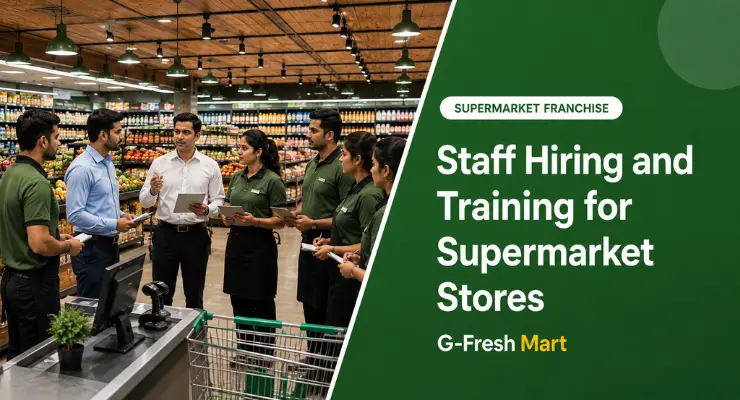
Solution: Use franchise hiring support during setup rather than hiring independently under pressure. Train every staff member on the billing system before they serve a single customer – billing errors in front of customers damage a new store’s reputation faster than almost anything else. Cross-train each staff member on at least one additional role so the store operates normally on any absence. Pay at or above local market rates and attach a small monthly bonus to measurable targets (zero billing discrepancies, or weekly revenue hitting a specific threshold) to reduce turnover.
G-Fresh Mart Franchise: G-Fresh Mart provides staff training as part of the 45-day setup process, covering billing procedures, FIFO stock rotation, customer service standards, and daily reconciliation. Lifetime free billing software training for all staff means every new hire throughout the franchise term can be trained at no additional cost – removing the ongoing training expense that erodes margin in stores that pay for external training each time a staff member leaves.
Problem 07: Customer Retention
| Impact: Flat or declining repeat visit frequency | Root cause: Transactional relationship with customers; no active retention mechanism |
Solution: Customer retention in a neighbourhood grocery franchise is built through three specific habits: personal recognition of regular customers by name and preference (this is what quick commerce apps cannot replicate), consistent availability of the products customers come specifically for (a single stockout on a regular purchase motivates them to find an alternative), and active communication through a WhatsApp broadcast list with genuinely useful weekly offers. Handle every complaint personally and resolve it the same day – a customer whose complaint was resolved well is more loyal than a customer who never had a complaint.
G-Fresh Mart Franchise: G-Fresh Mart’s brand recognition reduces the effort required to earn initial customer trust. The franchise’s digital marketing drives new customer discovery while the cloud POS captures customer purchase data that enables progressively personalised service as the store builds its regular customer base.
Problem 08: Technology and Billing Systems
| Impact: Billing errors, ITC claim rejections, stock discrepancies | Root cause: Using the wrong billing system or not using the available system’s full functionality |
Solution: The billing and inventory system is the operational backbone of a supermarket franchise. It must be GST-compliant from Day 1 to ensure correct invoicing and ITC claims. It must include inventory tracking so stock decisions are based on data rather than visual estimates. It must generate daily and weekly sales reports by SKU that the owner reviews on a regular schedule – at minimum weekly. Configure the system correctly during setup and treat the weekly data review as a non-negotiable operational discipline rather than an optional extra.
G-Fresh Mart Franchise: G-Fresh Mart’s cloud POS handles GST-compliant billing, inventory management, reorder alerts, sales reporting, and margin tracking in one pre-configured system at Rs 50,000 plus GST one-time cost with lifetime training included. Three months of free backend purchase entry support ensures the system’s data is accurate from the first week – which is when the inventory management discipline matters most.
Problem 09: Marketing Challenges
| Impact: Low awareness in first 90 days; slow customer base build | Root cause: Waiting passively for brand awareness to build without local marketing activity |
Solution: Local marketing for a neighbourhood grocery franchise does not require paid advertising to be effective. The highest-impact zero-cost actions are: claiming your Google Business Profile before opening day so local searches find your store immediately, distributing flyers in a 500-metre radius 5 days before opening, building a WhatsApp broadcast list from personal contacts and growing it with every customer who visits in the first week, and placing 3-5 banners at visible local points for the first two weeks. After opening, send two WhatsApp messages per week to the list – a Monday offer update and a festival or seasonal message when relevant. Respond to every Google review within 48 hours.
G-Fresh Mart Franchise: G-Fresh Mart provides digital marketing support including social media promotion of new store openings and inclusion in the brand’s campaign activity. New franchisees are listed on the G-Fresh Mart website store locator and given a 2-year managed website listing. The brand’s growing national recognition also means that customers who have seen G-Fresh Mart content online recognise and trust the store when they walk past it for the first time.
Problem 10: Choosing the Right Location
| Impact: Long-term revenue ceiling set below what the investment requires to be profitable | Root cause: Choosing based on availability or personal convenience rather than catchment analysis |
Solution: Location selection is the highest-stakes decision in the entire franchise investment process. Once the lease is signed, the decision is locked for the full franchise term. Use this checklist before committing: 2,000 or more households within 1.5 km; no organised supermarket competitor within 1 km; ground floor with road visibility from 50 metres or more; accessible by foot, two-wheeler, and auto; commercially zoned (verified legally); rent below 8-10% of projected monthly revenue; consistent footfall verified at 8 AM, 12 PM, and 6 PM on both weekdays and weekends. Visit the proposed location at all these times before making any financial commitment.
G-Fresh Mart Franchise: G-Fresh Mart conducts a formal site survey before approving any franchise location, assessing catchment population, household income profile, competition proximity, commercial zoning, and footfall patterns at no additional cost. This survey has prevented franchise owners from committing to locations that would have underperformed their investment. Choosing a location without a formal site assessment is the single most expensive mistake available to a new franchise owner – and it is what G-Fresh Mart’s approval process is specifically designed to prevent.
Check out this: G-Fresh Mart Supermarket Franchise: Your Complete Guide
How a Franchise Model Addresses These 10 Problems
The most honest summary of what a franchise does for a new store owner is this: it solves the problems that can be solved structurally, while giving better tools for the ones that require daily operational discipline. The franchise does not replace the owner’s judgment or effort – it reduces the number of things that have to be figured out from scratch.
| Problem | Independent Store | G-Fresh Mart Franchise |
| High initial investment | Owner estimates alone; no standard structure | Verified itemised breakdown; zero royalty 6 months; CGTMSE loan guidance |
| Inventory management | Manual tracking; owner-designed system | Cloud POS with reorder alerts; free purchase entry support |
| Supply chain | Individual negotiations; no collective leverage | 1,500-plus brand partnerships; pre-negotiated bulk pricing |
| Competition | Building from zero brand recognition | Immediate brand trust from Day 1 of trading |
| Low profit margins | Market-rate procurement; owner-chosen product mix | Centralised bulk pricing; layout standards positioning high-margin products |
| Staff recruitment and training | Informal hiring; no structured programme | Hiring support; structured training; lifetime software training |
| Customer retention | No systematic retention tool | POS customer data; brand-level trust as a foundation |
| Technology and billing | Self-selected; self-implemented | Pre-configured cloud POS; GST-compliant from Day 1; lifetime training |
| Marketing | Entirely owner-funded and managed | Brand campaigns; store locator; social media; 2-year website listing |
| Location | Self-assessed; no formal evaluation standard | Formal site survey; no location approved without assessment |
Managing These Problems Before They Manage You
The ten problems in this guide are not surprises for experienced supermarket operators.
They are the predictable operational and strategic challenges that every grocery store encounters at some point.
What separates stores that manage them successfully from those that struggle is whether the owner identified each problem early enough to address it before it compounded into a larger issue.
A franchise model significantly reduces exposure to several of these challenges by building the solutions into the system.
For the problems that remain in the owner’s hands – customer retention, local marketing, daily staff management, and the discipline of using operational data consistently – the franchise provides tools and guidance but not substitutes for engaged ownership.
If you are evaluating a supermarket franchise and want to understand how G-Fresh Mart’s system addresses these challenges in practice, apply for a free consultation or calculate your investment. A franchise advisor responds within 2 business days.
Frequently Asked Questions
What are the most common problems in supermarket franchise business in India?
The 10 most common problems are: high initial investment requirements, inventory management complexity, supply chain unreliability, intense market competition, low profit margins on staple categories, staff recruitment and training costs, customer retention challenges, technology and billing system issues, local marketing difficulties, and poor location selection. All 10 are manageable with specific operational solutions, and several are significantly reduced by operating within a structured franchise system.
How do you solve inventory management problems in a supermarket?
The three core practices are: setting automatic reorder alerts on your top 50 SKUs at a 7-day supply threshold, implementing FIFO stock rotation on every shelf fill without exception, and conducting a weekly near-expiry audit to move products within 30 days of expiry to a clearance section at 15-20% discount. These three habits together address most stockout, spoilage, and dead-stock issues within 4-6 weeks of consistent application.
Why are profit margins low in grocery retail and how can you improve them?
Grocery margins are structurally thin on commodity staples at 8-15% because these categories are highly price-competitive. Margin improvement comes from shifting the product mix toward higher-margin categories: personal care at 20-25%, snacks at 18-28%, beverages at 15-25%, and stationery at 25-28%. Reserving eye-level shelf space for these categories rather than staples consistently improves overall gross margin without changing the customer base or pricing structure.
What is the biggest mistake in choosing a supermarket franchise location?
The biggest mistake is choosing based on convenience or availability rather than systematic catchment analysis. A location should only be committed to after confirming: 2,000-plus households within 1.5 km, no organised competitor within 1 km, correct commercial zoning verified legally, rent below 8-10% of projected monthly revenue, and consistent footfall verified at multiple times of day on both weekdays and weekends. Signing a lease without this analysis locks in a performance ceiling for the entire franchise term.
How does a G-Fresh Mart franchise reduce these problems compared to an independent store?
G-Fresh Mart addresses 9 of the 10 problems structurally: investment through a verified cost breakdown and zero royalty period, inventory through cloud POS with reorder alerts, supply chain through 1,500-plus pre-negotiated brand partnerships, competition through immediate brand recognition, margins through centralised bulk procurement, staff through structured training with lifetime software training, technology through a pre-configured GST-compliant POS, marketing through brand campaigns and a store locator listing, and location through a formal site survey before any approval. Customer retention is the one where daily owner engagement remains the primary driver.