
Quick Answer
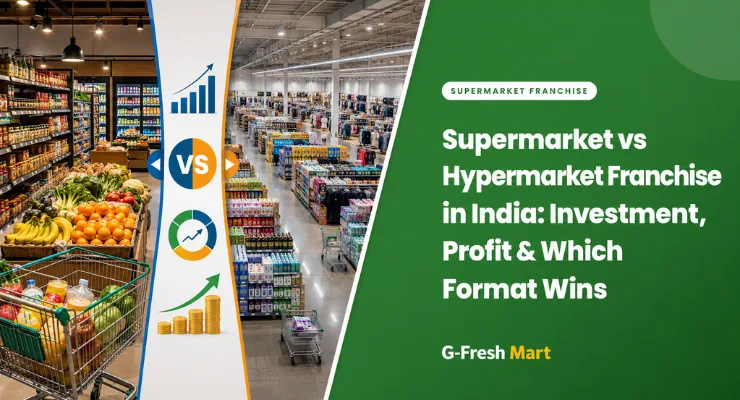
For franchise investors in India, a supermarket franchise (500-4,000 sq ft) is the better starting point – requiring ₹90 lakh investment with 20–25% gross margins and 12-30 month ROI. A hypermarket franchise (4,000-10,000 sq ft) requires ₹90 lakh to ₹2.5 crore with higher absolute monthly revenue but longer investment recovery of 24-36 months. G-Fresh Mart offers all three formats – Mini Mart, Super Mart, and Hyper Mart – on the same brand, supply chain, and support infrastructure. Most first-time investors are best suited to the Mini Mart or Super Mart format.
Introduction
When evaluating a supermarket or hypermarket franchise in India, the question is not which format is better in the abstract – it is which format is right for your investment capacity, available location, and target market.
Both formats are profitable. Both have a strong demand base in India’s growing organised retail sector.
The difference lies in capital requirement, operational complexity, revenue ceiling, and the type of customer they serve.
This guide answers the supermarket vs hypermarket franchise question in full – with real investment data, profit margin comparisons, location requirements, and a clear format recommendation based on your situation.
All figures are based on G-Fresh Mart’s franchise data across 400+ operational stores in 22+ states. If you are still deciding whether to invest at all, read our guide on the benefits of grocery franchise in India first.
What Is a Supermarket Franchise in India?
brand name in a space of 500 to 4,000 sq ft. In the G-Fresh Mart franchise system, the supermarket category includes two formats:
| Format | Size | Best Location Type | Primary Customer |
| Mini Mart | 500-1,000 sq ft | Residential colonies, Tier 2/3 towns, apartment complexes | Daily convenience shoppers – small basket, high frequency |
| Super Mart | 1,000-4,000 sq ft | High-footfall localities, market roads, Tier 1 city areas | Weekly family shoppers – larger basket, planned purchase |
Supermarket franchises in India are characterised by their focus on groceries, FMCG, personal care, and household essentials.
The product range is typically 5,000 to 20,000 SKUs depending on store size. They are positioned for daily and weekly shopping visits – not one-time bulk buying.
The key advantage of the supermarket format for franchise investors is its accessibility – lower investment, smaller space requirement, wider location options, and faster ramp-up to profitability.
See our complete guide to mini supermarket franchise in India for the full Mini Mart investment and setup breakdown.
What Is a Hypermarket Franchise in India?
A hypermarket franchise is a large-format retail store that combines a full supermarket with a general merchandise section – selling groceries, electronics, clothing, home furnishings, kitchen appliances, toys, and more in a space of 4,000 to 10,000+ sq ft. In the G-Fresh Mart system, this is the Hyper Mart format.
| Format | Size | Best Location Type | Primary Customer |
| Hyper Mart | 4,000-10,000 sq ft | Premium urban locations, retail parks, highway junctions, new commercial zones | Monthly bulk shoppers, families, urban consumers seeking all-in-one shopping |
Hypermarkets in India operate as destination stores rather than neighbourhood stores.
Customers travel specifically for the hypermarket experience – wide selection, bulk buying discounts, and the convenience of completing all shopping in a single visit.
This means location and parking are more critical for a hypermarket than for a supermarket.
For franchise investors, the hypermarket format offers significantly higher monthly revenue ceilings but requires substantially larger capital, a prime location with high natural footfall, and a longer timeline to reach breakeven.
Supermarket vs Hypermarket Franchise: 10-Point Comparison for Indian Investors
This comparison is designed specifically for franchise investment decisions – not for shoppers. Every data point is relevant to your capital allocation, location choice, and expected return.
| Factor | Supermarket Franchise (Mini/Super Mart) | Hypermarket Franchise (Hyper Mart) | Investor Verdict |
| Store Size | 500-4,000 sq ft | 4,000-10,000 sq ft | Supermarket needs less space – easier to find location |
| Total Investment | ₹14 lakh – ₹90 lakh | ₹90 lakh – ₹2.5 crore | Supermarket accessible to more investors |
| Franchise Fee | ₹2,10,000 + GST (same for all formats) | ₹2,10,000 + GST (same for all formats) | Equal – G-Fresh Mart charges no premium by format |
| Fit-Out Cost | ₹1.5L-₹15L depending on size | ₹15L-₹50L+ | Hypermarket fit-out 5-10x more expensive |
| Product Range | 5,000-20,000 SKUs (groceries + FMCG) | 20,000+ SKUs (groceries + general merchandise) | Hypermarket offers wider range but requires bigger buying budget |
| Gross Profit Margin | 20-25% | 18-28% (general merchandise pulls margin down) | Supermarket often delivers better margin per sq ft |
| Monthly Revenue Potential | ₹4L-₹35L | ₹35L-₹1.5 crore+ | Hypermarket higher ceiling but proportionally higher cost |
| Investment Recovery | 12-30 months | 24-36 months | Supermarket recovers investment faster |
| Location Requirement | Residential colony, market lane, commercial area | Prime road, retail park, large parking facility | Supermarket location is easier and cheaper to secure |
| Staff Required | 2-8 staff | 10-25+ staff | Supermarket easier to manage – lower payroll risk |
| Operational Complexity | Low-Medium | High | Supermarket better for first-time franchise investors |
| Suitable For | First-time investors, Tier 2/3 cities, ₹14L–₹90L budget | Experienced investors, metro/Tier 1, ₹90L+ budget | Format depends on your capital and market |
G-Fresh Mart’s Three Formats: Mini Mart, Super Mart & Hyper Mart – Compared
G-Fresh Mart is one of the few franchise brands in India that offers all three store formats under the same brand identity, supply chain, and operational infrastructure.
This means your learning from one format directly applies to scaling to the next.
Format 1 – Mini Mart (500-1,000 sq ft)
| Mini Mart Specification | Details |
| Floor Area | 500-1,000 sq ft |
| Best Location | Residential colony ground floor, apartment complex entrance, Tier 2/3 market area |
| Total Investment | ₹14 lakh – ₹25 lakh (all-inclusive) |
| Franchise Fee | ₹2,10,000 + GST |
| Software Fee | ₹50,000 + GST |
| Product Range | 5,000-12,000 SKUs – daily FMCG, dairy, staples, snacks, personal care |
| Gross Profit Margin | 20-25% |
| Expected Monthly Revenue | ₹4 lakh – ₹12 lakh |
| Expected Net Profit | ₹35,000 – ₹2,50,000/month |
| Investment Recovery | 12-24 months |
| Staff Required | 2-4 people |
| Setup Timeline | 45 days (guaranteed) |
| Best For | First-time investors, Tier 2/3 cities, low-capital entry |
Format 2 – Super Mart (1,000-4,000 sq ft)
| Super Mart Specification | Details |
| Floor Area | 1,000-4,000 sq ft |
| Best Location | High-footfall commercial area, main market road, busy residential locality, Tier 1/2 city |
| Total Investment | ₹25 lakh – ₹90 lakh |
| Product Range | 12,000-20,000 SKUs – full FMCG, dairy, fresh produce, home care, baby care |
| Gross Profit Margin | 20-25% |
| Expected Monthly Revenue | ₹12 lakh – ₹35 lakh |
| Expected Net Profit | ₹1,00,000 – ₹5,00,000/month |
| Investment Recovery | 18-30 months |
| Staff Required | 4-10 people |
| Setup Timeline | 45 days (guaranteed) |
| Best For | Experienced investors, metro/Tier 1 cities, ₹30L+ capital |
Format 3 – Hyper Mart (4,000-10,000 sq ft)
| Hyper Mart Specification | Details |
| Floor Area | 4,000-10,000 sq ft |
| Best Location | Premium urban area, retail park, commercial complex, highway junction with large parking |
| Total Investment | ₹90 lakh – ₹2.5 crore |
| Product Range | 20,000+ SKUs – full grocery + household + seasonal + general merchandise |
| Gross Profit Margin | 18-28% (lower due to general merchandise mix) |
| Expected Monthly Revenue | ₹35 lakh – ₹1.5 crore+ |
| Expected Net Profit | ₹3,00,000 – ₹15,00,000/month |
| Investment Recovery | 24-36 months |
| Staff Required | 12-30 people |
| Setup Timeline | 60-90 days (custom fit-out) |
| Best For | High-capital investors, premium urban locations, experienced retail operators |
For the complete investment breakdown across all formats: Supermarket Franchise Cost in India 2026
Investment Comparison: What ₹25 Lakh Buys You in Each Format
One of the most useful ways to compare formats is to ask: if I have a fixed capital amount, which format gives me the best return? Here is a side-by-side scenario for ₹25 lakh of available capital:
| Scenario | Mini Mart (₹25L budget) | Super Mart (₹25L budget) | Hyper Mart (₹25L budget) |
| Store format | 1 well-equipped Mini Mart (700-900 sq ft) | 1 basic Super Mart (1,500 sq ft) – tight fit-out budget | Not viable – minimum ₹75L required |
| Expected monthly revenue | ₹6-10 lakh | ₹8-15 lakh | N/A |
| Expected net profit | ₹60,000-₹2,00,000/month | ₹70,000-₹2,50,000/month | N/A |
| Investment recovery | 12-18 months | 18-24 months | N/A |
| Operational risk | Low – manageable with 2–3 staff | Medium – needs experienced manager | N/A |
| Recommendation | ✅ Strong fit – excess capital available as working capital buffer | ✅ Viable – execute fit-out carefully to stay in budget | ❌ Insufficient capital – wait until ₹75L+ available |
Use our franchise investment calculator to model your specific scenario based on your city, available space, and capital.
Profit Margins: Supermarket vs Hypermarket – Which Earns More Per Rupee Invested?
The profit margin question for supermarket vs hypermarket franchise has two parts: gross margin percentage AND net profit per rupee of capital invested.
A hypermarket may generate higher absolute monthly profit, but if it required 5x the capital, the ROI per rupee may be lower than a Mini Mart.
| Metric | Mini Mart | Super Mart | Hyper Mart | Key Insight |
| Gross Margin | 20-25% | 20-25% | 20-28% | Supermarket formats earn higher % margins – general merchandise in Hyper Mart dilutes the mix |
| Net Margin | 10-20% | 10-18% | 8-15% | Higher operating costs (rent, staff, utilities) compress Hyper Mart net margins |
| Monthly Net Profit | ₹35K-₹2.5L | ₹1L-₹5L | ₹3L-₹15L+ | Hyper Mart wins on absolute ₹ – but requires 5–10x more capital |
| ROI on Capital | High – low investment, fast recovery | Medium-High | Medium – high capital, long recovery | Mini Mart delivers best ROI per rupee of invested capital |
| Breakeven Timeline | 6-12 months | 9-18 months | 18-30 months | Supermarket formats reach profitability significantly faster |
Key Insight for Franchise Investors
A Mini Mart in a well-chosen residential location often delivers better returns per rupee of investment than a Hyper Mart – because the capital required is 5-10x lower while the margin percentage is actually higher. Many G-Fresh Mart franchisees who start with a Mini Mart expand to a Super Mart or second Mini Mart within 2-3 years, using profits from the first store to fund expansion without taking on additional capital risk.
Location Requirements: Supermarket vs Hypermarket Franchise
Location selection is the most important decision in any retail franchise. The requirements differ significantly between supermarket and hypermarket formats.
Read our complete guide to choosing the perfect supermarket location for the full site selection framework, including a scoring matrix.
| Location Factor | Supermarket Franchise (Mini/Super Mart) | Hypermarket Franchise (Hyper Mart) |
| Minimum catchment population | 5,000-10,000 households within 1-3 km | 30,000+ households or 1 lakh+ daily commuters within 5 km |
| Parking requirement | 4+ spaces per 1,000 sq ft – often street parking suffices | Dedicated parking for 50-200+ cars minimum |
| Location type | Residential colony, market lane, main road frontage | Main road with high visibility, retail park, commercial complex |
| Rent (monthly – Tier 2 city) | ₹15,000-₹50,000 | ₹80,000-₹3,00,000+ |
| Rent (monthly – metro city) | ₹40,000-₹1,50,000 | ₹2,00,000-₹8,00,000+ |
| Competitor proximity concern | No organised grocery within 500m | No hypermarket within 3 km |
| Ease of location finding | High – hundreds of viable locations in most cities | Low – very specific requirements limit options |
| Location approval by G-Fresh Mart | Free site survey included | Free site survey + detailed catchment report |
Day-to-Day Operations: Supermarket vs Hypermarket Franchise
Operational complexity is a significant differentiator between the two formats – and one that many investors underestimate before opening.
Supermarket (Mini/Super Mart) Operations
- Staff management: 2-10 people – straightforward roster, simple training
Inventory management: 5,000-20,000 SKUs – manageable with G-Fresh billing software - Daily routine: restock shelves, process transactions, manage fresh produce rotation
- Customer service: personal, neighbourhood relationships – builds strong loyalty
- Vendor management: handled through G-Fresh central supply chain – minimal owner involvement
- Owner time required: 4-6 hours daily for store visits and review – manageable alongside other commitments
Hypermarket (Hyper Mart) Operations
- Staff management: 12-30+ people – shift scheduling, department managers, HR complexity
- Inventory management: 20,000+ SKUs across multiple departments – requires dedicated inventory manager
- Daily routine: multiple department restocking, broader fresh produce management, non-food product merchandising
- Customer service: more transactional – less neighbourhood relationship building
- Vendor management: some general merchandise categories may require additional supplier negotiations
- Owner time required: 6-10 hours daily in Year 1 – significant personal involvement needed
⚠️ First-Time Investor Warning
If you are opening your first franchise store, starting with a Hyper Mart is high risk. The operational complexity – managing 25+ staff, 20,000+ SKUs across multiple departments, large footfall, and complex daily logistics – is significantly harder than a Mini Mart. G-Fresh Mart strongly recommends that first-time investors start with Mini Mart, master the operations model, then scale to Super Mart or Hyper Mart from a position of experience and financial stability.
Supermarket vs Hypermarket Franchise: Which Format Is Right for You?
Use this decision framework to identify the right format based on your specific situation:
| Your Situation | Recommended Format | Reason |
| First-time franchise investor with ₹14-25 lakh | Mini Mart | Lowest risk, fastest ROI, manageable with minimal experience |
| First-time investor with ₹25-60 lakh | Super Mart in a good Tier 2 location | Higher revenue ceiling – manageable if location is strong |
| Experienced investor, ₹60-75 lakh, strong location available | Super Mart or consider Hyper Mart | At this budget, a Super Mart is well-capitalised; Hyper Mart is possible in prime location |
| High-capital investor with ₹75L+ and prime urban location | Hyper Mart | Highest absolute revenue – but only with strong location and operational readiness |
| Living in Tier 2/3 city | Mini Mart | Lower rent, less competition, proven G-Fresh model in Tier 2/3 already |
| Available location is a residential colony | Mini Mart | Perfect format for colony – captive audience, daily repeat visits |
| Available location is a main market road | Super Mart or Mini Mart | Higher footfall warrants larger format if capital allows |
| Want to scale to multiple stores | Start with Mini Mart × 2-3 | Faster ROI, lower risk, and proven model before larger format commitment |
Why G-Fresh Mart Is the Ideal Franchise Partner for Any Format
The decision between supermarket and hypermarket franchise is important – but choosing the right franchise partner is equally critical.
Here is what G-Fresh Mart provides regardless of which format you choose:
| Support Element | What G-Fresh Mart Provides | Why It Matters for Format Decision |
| Same franchise fee across all formats | ₹2,10,000 + GST – no premium for larger formats | Larger format investment goes to fit-out, not to the franchisor |
| Same supply chain for all formats | 20,000+ products from 1,500+ brands available regardless of format | You access the full product range from Day 1 – Mini or Hyper |
| Same billing software | Cloud-based POS scales from 1 billing counter to 10+ | Same software whether you start Mini or scale to Hyper |
| Free site survey for all formats | Population analysis, competitor audit, territory approval | Location guidance calibrated to your specific format’s requirements |
| 45-day setup guarantee | Applies to Mini Mart and Super Mart – Hyper Mart is 60–90 days | Firm opening timeline regardless of format |
| Lifetime franchise manager | Dedicated support person for the life of your franchise | Ongoing guidance as you scale from one format to the next |
| Format upgrade path | Mini → Super → Hyper supported by same franchise team | Start small, scale up – no need to change franchise partner |
For the complete overview of all franchise benefits: 12 Benefits of Investing in a Grocery Franchise in India
For the step-by-step process to get started: How to Start a Supermarket Franchise in India
5 Mistakes Investors Make When Choosing Between Supermarket and Hypermarket Franchise
Mistake 1 – Choosing Hyper Mart for the Higher Revenue Number
Monthly revenue of ₹35-50 lakh sounds more impressive than ₹5-10 lakh. But if the Hyper Mart required ₹1.5 crore to build and the Mini Mart required ₹15 lakh, the Mini Mart may deliver a far better annual return on invested capital.
Always evaluate ROI as a percentage of investment – not absolute monthly revenue.
Mistake 2 – Underestimating Hyper Mart Location Requirements
A Hyper Mart needs a very specific type of location – minimum 4,000 sq ft in a high-footfall area with dedicated parking. In most Indian cities, locations that truly meet this specification are rare and expensive.
Many investors choose a Hyper Mart budget and then compromise on location because the ideal site is unavailable or unaffordable. A Mini Mart in the right location outperforms a Hyper Mart in the wrong location every time.
Mistake 3 – Starting With Hyper Mart Without Retail Experience
Hyper Mart operations require managing 20-30 staff across multiple departments with complex daily inventory cycles. Investors who have never managed a retail operation before routinely underestimate this complexity.
G-Fresh Mart’s strong recommendation is to start with Mini Mart, master the model, then expand. The operational learning from a Mini Mart is directly applicable to running a Hyper Mart – and far cheaper to acquire.
Mistake 4 – Ignoring Gross Margin Percentage Differences
Hypermarkets carry general merchandise – electronics, clothing, home goods – which typically earn margins of 8–15%, significantly lower than FMCG’s 20-35%.
A Hyper Mart’s blended gross margin is therefore lower than a pure-grocery supermarket. Investors who plan their Hyper Mart P&L using supermarket margins will face a shortfall. Always model the actual blended margin based on your planned product mix.
Mistake 5 – Not Using G-Fresh Mart’s Free Site Survey
Before committing to a format, G-Fresh Mart provides a free site survey that analyses your proposed location’s suitability for your chosen format.
Many investors make their format decision based on the space available, then discover through the site survey that the location’s catchment population or traffic pattern is better suited to a different format.
Use the site survey before signing the lease – it is free and can save you from an expensive format mismatch.
Frequently Asked Questions
Which is more profitable – supermarket or hypermarket franchise in India?
On a return-on-investment basis, a well-located supermarket franchise (Mini Mart or Super Mart) is typically more profitable per rupee of invested capital. Supermarket formats deliver gross margins of 20-35% and recover investment in 12-30 months. Hypermarkets deliver higher absolute monthly profit but require 5-10x more capital and take 24-36 months to recover investment. For most investors, starting with a supermarket format delivers superior capital efficiency.
What is the minimum investment for a supermarket franchise vs hypermarket franchise?
A G-Fresh Mart Mini Mart supermarket franchise starts at ₹14 lakh (all-inclusive for 500–1,000 sq ft in a Tier 2/3 city). A Super Mart starts at ₹25 lakh. A Hyper Mart requires a minimum of ₹90 lakh, with most viable Hyper Mart setups requiring ₹1 crore or more when including prime location fit-out and initial inventory.
Can I start with a Mini Mart and later upgrade to a Hyper Mart?
Yes. G-Fresh Mart’s franchise system is specifically designed to support this progression. The same brand, supply chain, billing software, and operational system that runs your Mini Mart will scale to a Super Mart or Hyper Mart. Many G-Fresh Mart franchisees have used profits from their first Mini Mart to fund a second Mini Mart or an upgrade to Super Mart format within 2-3 years of their first opening.
Which format is better for a Tier 2 city in India – supermarket or hypermarket?
For Tier 2 and Tier 3 cities, the Mini Mart or Super Mart format is strongly recommended. These formats are proven in G-Fresh Mart’s existing Tier 2/3 store network, require lower investment (matching Tier 2 city rent economics), and face less competition from national chains. A Hyper Mart in a Tier 2 city requires a very specific high-footfall location that is difficult to find and rarely cost-effective at Tier 2 rent levels.
Does G-Fresh Mart offer all three formats – Mini Mart, Super Mart, and Hyper Mart?
Yes. G-Fresh Mart is one of the few franchise brands in India that offers all three store formats under the same brand identity, supply chain, and operational support infrastructure. The franchise fee (₹2,10,000 + GST) is the same across all formats. The difference in total investment reflects the larger fit-out, refrigeration, and initial inventory requirements of bigger formats – not a higher franchise fee.
What is the difference between supermarket and hypermarket in terms of product range?
In the G-Fresh Mart system, a Mini Mart typically stocks 5,000-12,000 SKUs covering daily FMCG, dairy, staples, snacks, and personal care. A Super Mart stocks 12,000-20,000 SKUs with additional categories. A Hyper Mart stocks 20,000+ SKUs and adds general merchandise categories like kitchen appliances, seasonal items, home furnishings, and in some locations, ready-to-eat food sections.
How long does it take to open a supermarket vs hypermarket franchise?
G-Fresh Mart guarantees a 45-day setup timeline for Mini Mart and Super Mart formats, measured from the date the franchise agreement is signed. This covers site fit-out, billing software installation, staff training, and initial stock procurement. The Hyper Mart format typically requires 60–90 days due to the larger fit-out scope, additional refrigeration units, and more complex staff training requirements.
How much space is needed for a supermarket franchise vs hypermarket franchise?
G-Fresh Mart’s Mini Mart format requires 500-1,000 sq ft. The Super Mart format requires 1,000-4,000 sq ft. The Hyper Mart format requires 4,000-10,000 sq ft. For context, a 500 sq ft Mini Mart is approximately the size of a large 2BHK flat – a commonly available ground-floor shop in any Indian residential area. A Hyper Mart requires space equivalent to a small office building.