
Quick Definition
A good supermarket location is a spot where enough nearby customers can easily see it, reach it, and afford to shop there regularly – with rent that matches what the area can earn, fair (not extreme) competition, and room for the area to grow.
At a Glance
- Most Indian grocery shoppers travel less than 2 km from home to buy groceries.
- G-Fresh Mart runs 400+ stores across 22+ states, and every single one passed a location survey before it opened.
- A Mini Mart needs 500-1,000 sq ft. A Super Mart needs 1,000-4,000 sq ft. A Hyper Mart can run up to 10,000 sq ft.
- Every G-Fresh Mart location, whether you find it or the team helps you find it, is checked before approval.
Introduction
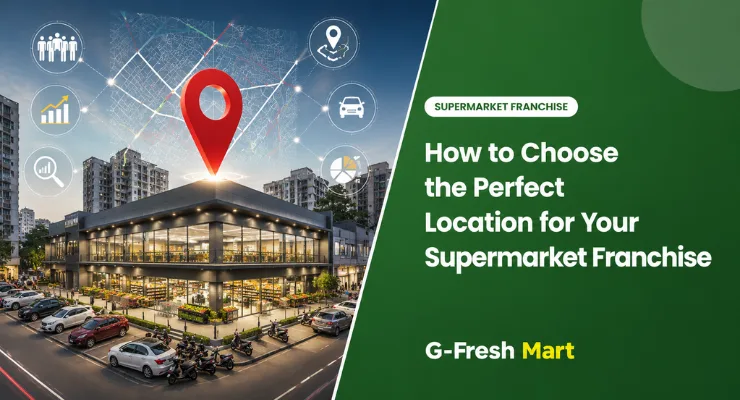
Where you open your supermarket matters more than almost anything else about your business.
You can have great products and fair prices, but if your shop sits in the wrong spot, customers simply won’t come.
This guide brings together everything G-Fresh Mart has learned from opening and supporting 400+ stores across India, so you can pick a location with confidence instead of guesswork.
This isn’t a theory piece. Every factor below comes from real site surveys G-Fresh Mart has run before approving actual stores, not from general business advice that could apply to any industry.
Where a number or fact is specific to G-Fresh Mart, it’s noted clearly, so you know what’s drawn from real experience versus general good practice.
Why Location Comes First
Your shop only earns money when people walk in. There’s no website or delivery app doing the work for you, just real people walking past and deciding to enter.
Most people don’t travel far for groceries. They shop close to home, almost out of habit. If your store isn’t nearby, people will go elsewhere, even if your prices are better.
A location that’s easy to see also brings in customers who weren’t even planning to shop that day. They notice your store, and they walk in. That’s free advertising you don’t have to pay for.
So yes, rent may cost more in a busy area. But a busy area also brings in more sales.
A cheap, quiet corner might save you money every month, but it can also quietly stop your business from growing past a certain point.
Here’s a simple way to think about it. If a busy location costs 20% more in rent but brings in 50% more daily customers, the extra rent is easily worth it.
The mistake most first-time store owners make is comparing only the rent, and never comparing what that rent actually buys you in terms of customers walking through the door
Also Read: Profit or Pitfall? Supermarket Franchise Location Tips
What Makes a Location Good? 7 Simple Things to Check
1. Who Lives Nearby (Your “Catchment Area”)
In simple words, your catchment area is just the neighbourhood around your shop where most of your customers will come from, usually within 1-2 km.
Don’t just count how many people live there. Look at what kind of people they are.
Do they have steady jobs? Do they spend on groceries regularly? A middle-class neighbourhood with working families usually buys more often than a very crowded but low-income area, even if that area has more people overall.
The type of family matters too. Bigger families buy more household items in bulk.
Areas full of young, single working people often want ready-to-eat food instead. Knowing this before you open helps you stock the right products from day one, instead of finding out the hard way three months in.
Here’s a simple example. Two shops of the same size, in two different neighbourhoods, can have very different results.
One sits in a crowded area where most families earn just enough to cover daily needs.
The other sits in a smaller but steadier neighbourhood where most households have two working adults.
The second shop, despite seeing fewer people walk past each day, often does better business, because the people who do walk in actually spend more, and spend more often.
2. Can People See and Reach Your Shop (“Visibility” and “Accessibility”)
A shop on a busy road or near a society gate gets noticed easily. People walking by remember it, even if they hadn’t planned to stop.
But being seen isn’t enough. People also need an easy way to reach you.
If parking is hard to find, or the lane leading to your shop is too narrow, customers may simply choose another store, even one a little further away.
Look for a shop with a clear front, easy-to-read signage, and a simple way in and out.
3. Who Else Is Selling Nearby
Other shops nearby aren’t automatically bad news. In fact, they prove that people in the area do buy groceries regularly. What matters is studying them closely.
Maybe the local kirana store close by doesn’t stock enough variety.
Maybe the supermarket two streets away charges more than your target customer wants to pay. That gap is your opportunity.
Try to avoid two extremes: an area with zero shops nearby (which can be a sign of low demand), and an area already packed with strong, established competitors.
A moderately busy area, where demand is proven but no single store dominates, usually works best.
A simple way to check this yourself: walk the area on a regular weekday evening and count how many people are actually carrying shopping bags.
That single observation often tells you more than any amount of guessing.
4. Rent vs What You Can Actually Earn
Many new shop owners make the same mistake: they pick the cheapest rent they can find. But a cheap shop in a quiet area often earns less, too.
Instead, ask yourself a simple question: will this location bring in enough customers to make the rent worth paying?
A slightly higher rent in a genuinely busy area usually pays for itself many times over through extra daily sales.
Think of rent as an investment that should work for you, not just a monthly cost to minimise.
5. Is the Area Growing?
Some of today’s best-performing supermarket locations were quiet and unremarkable just a few years ago.
Look for early signs of change: new homes being built, new offices opening, a new school, or a planned road or metro line.
If you see these signs, the area is likely to grow. Opening your store early in a growing area means lower rent today, and a bigger customer base later as more people move in.
6. Local Rules and Basic Facilities
Before you fall in love with a shop, check whether it’s actually allowed to run a supermarket there.
This is sometimes called “zoning” – in simple words, it just means local rules about what kind of business can open in that area, including signage and parking rules.
Some areas don’t allow large retail signage, or require a minimum number of parking spots.
Also read your lease carefully. Does the rent go up every year? Who pays for repairs? How long are you locked into the agreement? And don’t skip the basics: steady electricity and water.
A shop with frequent power cuts means extra cost for backup power, and spoiled stock if your fridges go off at the wrong time.
7. How Close Are Your Suppliers?
Think about how your stock will actually reach your store. A shop near main roads, or close to your main supplier, gets restocked faster and costs less per delivery.
This matters more in smaller towns, where supply routes are limited, and a little less in big cities, where you usually have several supplier options nearby.
Quick Checklist Before You Decide
| What to Check | Why It Matters |
| Catchment area | Are nearby customers willing and able to spend? |
| Footfall | How many people naturally pass by each day? |
| Visibility | Can people see your shop without trying? |
| Accessibility | Is parking and entry genuinely easy? |
| Competition | Is the area under-served or over-saturated? |
| Rent vs earnings | Does expected revenue justify the rent? |
| Zoning and lease | Is the business legally allowed here, and on what lease terms? |
| Utilities | Is power and water supply reliable? |
| Supplier distance | How fast and cheap is restocking? |
| Store size | Is there enough space for your chosen format? |
| Growth signals | Is the area developing, or already mature? |
Which Type of Area Should You Choose?
| Area Type | Best Reason to Pick It | Biggest Trade-off |
| Village or small town | Low rent, low competition, loyal customers | Fewer customers overall, lower spending per visit |
| City | High footfall, fast sales, easy hiring | High rent, smaller shops, intense competition |
| Outskirts / residential | Loyal family customers, moderate competition | Fewer walk-ins, parking matters more |
| Inside a mall | High visibility, ready-to-spend crowd | High total cost, competing with non-grocery shops |
Village or small town areas mean less rent and less competition, and people tend to recognise and trust you quickly.
The downside is a smaller overall customer base, and people there usually spend less per visit, so you may not be able to justify stocking a wide variety of products.
City areas bring big crowds, fast sales, and it’s easy to find staff to hire, since the area is full of workers.
The cost is real estate: rent is high, shops tend to be smaller because space is expensive, and you’ll be competing with several big, established stores for the same customers.
Outskirts and residential areas attract families who shop regularly and stay loyal once you’ve earned their trust, with less competition than a busy city centre.
But fewer people walk past naturally, since most residents drive rather than walk, so parking becomes an important factor here.
Mall locations offer strong visibility and a crowd that’s often already planning to spend money that day.
But rent is high, you’ll usually pay extra for shared mall costs like security and maintenance, and many visitors come for clothes or movies, not groceries, so your store has to work harder to earn their attention.
How to Pick a Location for Your Supermarket Franchise, Step by Step
1. Decide your store format first: A small Mini Mart needs a different kind of spot than a bigger Super Mart, so settle this before you start looking at properties.
2. Study the area: Look at who lives there, who’s already selling groceries nearby, and how busy the roads and footpaths actually are at different times of day.
3. Build your own simple checklist: using the points above, so you’re comparing every site fairly instead of going on first impression.
4. Visit shortlisted places in person: Numbers on paper can’t tell you everything. Walk the area at different times of day and see it for yourself.
5. Do the math before you fall in love with a site: Will realistic expected sales comfortably cover rent, staff, and other monthly costs?
6. Negotiate and finalise: Discuss lease length, rent increases, and any landlord conditions clearly, and don’t sign until every zoning and legal question has a confirmed answer.
Even after you open, this isn’t a one-time decision. A new competitor opening nearby, a delayed road project, or new homes being built can all change how your location performs.
Revisit your assumptions every few months, especially if sales start to plateau unexpectedly.
Check out this: Supermarket Franchise Cost in India: The Complete 2026 Breakdown
Common Location Mistakes to Avoid
- Choosing low rent over a busier spot: It protects your monthly budget but quietly caps how much you can ever earn.
- Underestimating visibility: A shop hidden in a side lane or basement loses the free, passive marketing a visible storefront naturally provides.
- Skipping a real catchment study: Assuming any nearby population will spend like your ideal customer leads to the wrong product mix and pricing.
- Misreading competition: Avoiding all competition or walking into an already crowded market are both worse choices than a moderately competitive area.
- Ignoring zoning and lease fine print: A great-looking site can be disqualified later by signage rules, parking norms, or a lease clause you didn’t read closely.
- Treating site selection as a one-time decision: Conditions change after you open; check your assumptions periodically.
- Picking a shop too small for your stock: A cramped layout doesn’t just look bad; it lowers how much each customer ends up buying, because they can’t browse comfortably.
How G-Fresh Mart Helps You Get This Right
Evaluating all seven factors above on your own can feel overwhelming, especially if this is your first store.
That’s exactly why G-Fresh Mart doesn’t leave it to chance. Every proposed location, whether you find it yourself or ask our team to suggest one, goes through a formal site survey before we approve it.
The survey checks population density, local spending power, and genuine demand to confirm the area can support your chosen format, whether that’s a 500-1,000 sq ft Mini Mart, a 1,000-4,000 sq ft Super Mart, or a larger Hyper Mart.
If a proposed site doesn’t pass, our team typically suggests an adjustment, like a different street or a different format size, rather than simply rejecting the opportunity.
This is the same process every one of G-Fresh Mart’s 400+ existing stores went through before opening.
For example, one G-Fresh Mart store in Bihar runs out of a 6,000 sq ft space, another in Tamil Nadu operates from 3,500 sq ft, and a smaller 3,000 sq ft store serves Chittaurgarh in Rajasthan.
Each of these passed the same survey checking local population, spending power, and demand before opening, which is exactly why they’re still running today.
So when you apply for a G-Fresh Mart franchise, you’re not guessing alone. You’re following a system that’s already worked hundreds of times across India.
You can also use the G-Fresh Mart franchise investment calculator to see how your chosen format and location affect your total setup cost before you commit.
Ready to Find Your Spot?
Picking the right location is the single biggest decision you’ll make before opening your supermarket.
Take your time, work through this guide, and don’t be afraid to ask for help along the way.
Every factor here matters less on its own than it does combined with the others, so resist the urge to fall in love with a site after checking just one or two boxes.
If you’d like support from a team that has done this successfully more than 400 times, apply for a G-Fresh Mart franchise and have your proposed location assessed through the same trusted site survey process used across every existing store, or use the calculator first to see what your investment could look like.
Quick Questions People Ask
What is the ideal location for a supermarket franchise?
A dense residential area with genuine spending power, strong visibility, easy access, and moderate rather than extreme competition. It should sit naturally within your target customer’s daily routine, not just somewhere with a high raw population count.
Does footfall really matter that much?
Yes. Most supermarket sales come from people walking in, not from planned, advance visits. Higher daily footfall in your immediate area usually means higher daily sales, all else being equal.
Should I choose cheap rent or a busy spot?
In most cases, a busier spot is worth the extra rent. The added cost is usually justified by the extra daily sales it brings in, while a cheap but quiet location can quietly limit your growth.
How much space do I actually need?
It depends on your format. A Mini Mart needs roughly 500-1,000 sq ft. A Super Mart needs 1,000-4,000 sq ft. A larger Hyper Mart format can run up to 10,000 sq ft.
Is a shopping mall a good location for a supermarket?
It can be, mainly because of the visibility and ready-to-spend crowd. But total occupancy costs are usually higher once shared mall charges are added, and you’ll be competing with non-grocery shops for the same customer attention.
Do I need any government approval for my location?
Yes. Always confirm local zoning allows retail use, and check parking and signage rules before signing any lease. These requirements vary by area, so check your specific site rather than assuming it matches a similar property nearby.
Can two G-Fresh Mart stores be located close to each other?
No. G-Fresh Mart gives each franchisee an exclusive territory, so the brand will not approve a second store inside your protected area. This is part of why the site survey checks local demand so carefully before approving any new location.
What happens if my proposed location doesn’t get approved?
G-Fresh Mart’s team will usually suggest an alternative, such as a different street nearby or a different store format size, rather than simply turning down your application. The goal of the survey is to find a workable location, not to disqualify you.
How long does the site survey take?
It depends on how quickly your documentation and proposed location details are submitted, but it’s designed to move alongside the rest of your application rather than holding it up.