
Quick Answer
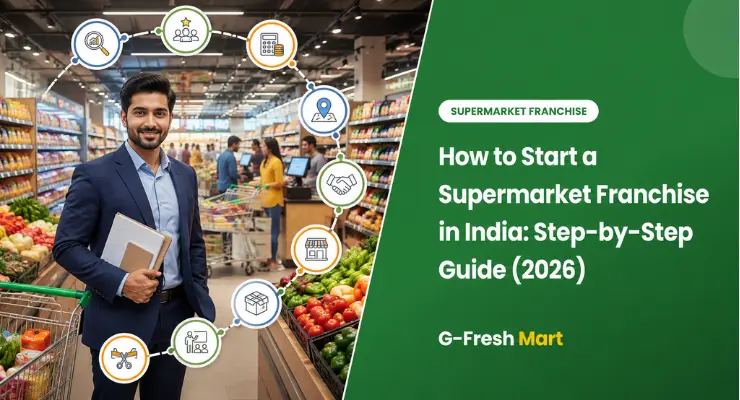
Starting a supermarket franchise in India takes 7 steps:
- Conduct market and location research
- Choose a franchise brand and format
- Plan your investment
- Complete all legal registrations
- Set up your store
- Hire and train staff, and
- Launch with a marketing plan.
With G-Fresh Mart’s FOFO model, the full process – from site approval to opening day – takes 45 days.
Investment starts at 14 lakh for a Mini Mart (500–1,000 sq ft) and goes up to ₹90 lakh for a Hyper Mart (4,000–10,000 sq ft).
Use the G-Fresh Mart franchise cost calculator for an investment estimate specific to your city and store size.
Introduction
A supermarket franchise in India is one of the most viable business investments available in 2026.
India’s organised grocery retail sector – currently valued at approximately 60 lakh crore – is growing at 16% annually according to IBEF, and organised franchise formats still account for less than 15% of total grocery retail. That gap represents your opportunity.
This guide brings together everything you need to know to start a supermarket franchise in India – market research, brand selection, investment planning, legal requirements, store setup, staff training, and marketing – in one place, in the order you actually need to do it.
The steps below are drawn from G-Fresh Mart’s own 45-day franchise setup process, refined across 400+ store openings in 22 states since 2017.
Whether you are evaluating your first franchise or ready to sign, this is your complete reference.
Why a Supermarket Franchise Is One of India’s Smartest Business Investments
Before getting into the steps, it helps to understand what makes grocery retail franchising different from other franchise categories – and why so many first-time investors choose it.
| Factor | Supermarket Franchise | F&B / Restaurant | Education / Coaching |
| Demand type | Daily, year-round | Seasonal & location-sensitive | Academic calendar cycles |
| Customer return rate | 60-70% repeat weekly | 25-40% repeat | Relationship-dependent |
| Inventory turnover | 7-14 days | 1-3 days (perishable risk) | No physical inventory |
| Tier 2/3 city viability | High – works anywhere | Limited – needs footfall density | Moderate |
| Average gross margin | 18–25% | 40-60% but high wastage | 30-50% |
| Typical ROI timeline | 12–24 months | 18-36 months | 24-36 months |
| First-time investor risk | Low-Medium | Medium-High | Low-Medium |
Three factors stand out: grocery demand is daily and recession-resistant, repeat customer rates are among the highest in retail, and the format works in every city size from metro to Tier 3.
These qualities are why supermarket franchises consistently outperform other sectors for first-time Indian investors.
Also Read: Top 10 Supermarket Franchises in India 2026: Investment, ROI & Full Comparison
How to Start a Supermarket Franchise in India: The 7 Steps
1. Conduct Market Research and Feasibility Study
Timeline: 1-2 weeks before any commitment
Market research is not optional – it is the difference between choosing a location that hits ₹8 lakh monthly revenue in year one and choosing one that struggles to cover rent. Do it before you speak to any franchisor.
What to Research
- Demographics: Study the population within 1–2 km of your target location. Count total households, average household income, age distribution, and primary occupations. A residential colony of 3,000+ households within 1.5 km is a strong base for a Mini Mart.
- Competition mapping: Walk the area and list every existing grocery store, kirana shop, and supermarket within 2 km. Note their size, product range, approximate pricing, and how busy they appear at peak and off-peak hours. Your goal is not to avoid competition – it is to find the gap.
- Demand analysis: Identify which product categories are underserved. If the nearest supermarket has weak fresh produce or poor personal care stock, those become your early competitive advantages.
- Shopping behaviour: Talk to 10–15 local residents about where they currently shop, what they wish was available, and how often they visit a supermarket. This takes two hours and saves months of guessing.
- Location feasibility: Assess footfall at different times – 8 AM, 12 PM, 6 PM, and weekends. A location with flat footfall throughout the day performs more predictably than one with sharp peaks.
SWOT Framework for Your Location
| SWOT | What to Assess |
| Strength | High residential density, lack of organised grocery nearby, good road access, ample parking |
| Weakness | High existing competition, low income demographic, poor parking, distant from main road |
| Opportunity | New residential projects nearby, growing Tier 2 market, underserved product categories |
| Threat | E-commerce delivery penetration, incoming organised competitor, seasonal demand dips |
G-Fresh Mart conducts a free site survey as part of its franchise application process. Their team assesses your proposed location against 15 parameters before you commit – including competition density, catchment household count, traffic pattern, and property suitability. This alone can save you lakhs in avoidable mistakes.
2. Choose the Right Franchise Brand and Format
Timeline: 1-2 weeks
Choosing the right franchise is the single most consequential decision in this process. The brand you choose determines your supply chain, your margin structure, the training you receive, and the ongoing support available when problems arise. Take this step seriously.
How to Evaluate a Franchise Brand
- Brand reputation: How many stores are operational – not announced, not planned, actually open and trading? A brand with 400+ operational stores across 22 states has proven it can scale. A brand with 12 stores is still proving it.
- Franchise fee and total cost transparency: Ask for a full cost breakdown in writing before any meeting. It should include franchise fee, software fee, security deposit, interior fit-out cost per sq ft, first stock requirement, and any ongoing royalties. If they are vague about any of these, it is a red flag.
- Royalty structure: Understand what percentage of revenue you pay and how often. Some brands charge a monthly royalty from Day 1; others offer royalty-free periods. G-Fresh Mart offers zero royalty for the first 6 months of operation.
- Support system: Ask specifically: What training do you provide and for how long? Do you have a helpline? How often do field representatives visit? What happens if my store struggles in Month 3?
- Territory exclusivity: Confirm whether the franchisor offers geographic exclusivity – a protected radius within which they will not open another franchise store. Without this, your own brand can become your competitor.
- Existing franchisee references: Ask for direct contact details of 3 existing store owners in your state or nearby city. Call them. Ask: Would you do this again? What surprised you? What does the franchisor do well – and poorly?
G-Fresh Mart: Three Formats for Three Investment Levels
G-Fresh Mart operates on the FOFO (Franchise Owned, Franchise Operated) model – you own the store, you keep the profit, and you benefit from G-Fresh’s supply chain, billing software, and brand. All three formats share the same 45-day setup timeline.
| Format | Store Size | Investment Range | SKU Access | Best For | Typical ROI |
| Mini Mart | 500-1,000 sq ft | ₹14L – ₹25L | 1,500+ brands | Residential areas, Tier 2/3 cities | 12-18 months |
| Super Mart | 1,000-4,000 sq ft | ₹25L – ₹90L | 10,000+ SKUs | Market lanes, semi-urban high-streets | 18-24 months |
| Hyper Mart | 4,000-10,000 sq ft | ₹90L – ₹2.5Cr | 20,000+ products | High-footfall urban locations | 24-36 months |
For most first-time investors with capital of ₹14L-₹25L, the Mini Mart format is the logical starting point.
It limits downside risk, allows you to learn store operations in a manageable environment, and still generates meaningful monthly revenue.
Opening a second store after proving the first is far easier than recovering from an overstretched first investment.
3. Plan Your Investment and Secure Funding
Timeline: 1-3 weeks
Underestimating total investment is the most common and most damaging mistake first-time franchise owners make. The franchise fee is just one of seven cost components. Plan for all of them before committing.
Full G-Fresh Mart Investment Breakdown (Mini Mart Format)
| Cost Component | Amount |
| Franchise Fee | ₹2,10,000 + GST |
| Billing Software (one-time) | ₹50,000 + GST |
| Security Deposit | ₹1,00,000 |
| Interior Cost | ₹6,00,000 |
| Purchasing Cost | ₹5,00,000 |
| TOTAL (Mini Mart estimate) | ₹14L – ₹25L |
Funding Options for Indian Franchise Investors
- Personal savings: The cleanest option – no interest, no approval wait, full control. If you have 60-70% of the investment in savings, self-fund and borrow only the balance.
- Bank loans – Mudra Loan (PMMY): For investments up to ₹10 lakh, the Pradhan Mantri Mudra Yojana offers collateral-free loans in three tiers: Shishu (up to ₹50,000), Kishore (₹50,000-₹5 lakh), and Tarun (₹5L-₹10L). Apply at any scheduled commercial bank or small finance bank.
- Bank loans – CGTMSE scheme: For investments up to ₹2 crore, the Credit Guarantee Fund Trust for Micro and Small Enterprises enables collateral-free loans for first-generation entrepreneurs. Ask your bank about this explicitly.
- Stand Up India: Designed for SC/ST entrepreneurs and women investors. Covers ₹10 lakh to ₹1 crore at competitive rates. Eligible for supermarket franchise setup costs.
- Business partnership: A silent investor who contributes capital in exchange for a fixed profit share (not operational involvement) reduces your personal risk without diluting your management control.
Rule of thumb: Never borrow more than 40% of your total investment. If your total budget is ₹20 lakh and you can only self-fund ₹8 lakh, either choose a smaller format or delay until your savings reach ₹12-14 lakh. Launching underfunded is the fastest path to franchise failure.
4. Complete All Legal Registrations and Licenses
Timeline: 2-4 weeks (run parallel with Step 3)
Legal compliance in India’s retail sector is non-negotiable. Missing a single license can result in store closure, fines, or inability to invoice customers. Start these applications as early as possible – some take 2-3 weeks for government processing.
Mandatory Licenses for a Supermarket Franchise in India
| License / Registration | What It Covers | Issued By | Approx. Time |
| Business Registration | Legal structure: Proprietorship, Partnership, LLP, or Pvt Ltd | MCA / Registrar of Firms | 3-7 days |
| GST Registration | Mandatory for billing and tax compliance (all turnovers above ₹40L) | GST Portal (gstin.gov.in) | 3-5 working days |
| FSSAI License | Required for selling any food or food products | Food Safety and Standards Authority of India | 7-30 days |
| Trade License | Grants legal right to trade from your specific premises | Municipal Corporation / Panchayat | 7-21 days |
| Establishment License | Registers store with local labour department | State Labour Department | 7-14 days |
| Shops & Establishment Act | Governs working hours, holidays, conditions | State Government | 7-14 days |
| Fire NOC | Required for stores above certain sq ft (varies by state) | Fire Department | 7-21 days |
| Franchise Agreement | Legal contract with G-Fresh Mart – outlines rights, fees, territory, duration | Signed with Franchisor | Before store setup |
Critical Documents to Prepare
- PAN Card and Aadhaar of the business owner
- Property documents: lease agreement or NOC from property owner
- Passport-size photographs (6 copies minimum)
- Bank account details in the business entity name
- Address proof of the proposed store location
- Cancelled cheque in the business name
G-Fresh Mart’s franchise team provides a complete documentation checklist at the time of application. Their operations team also guides first-time owners through the FSSAI and GST application process – particularly useful if you are new to business registration.
5. Set Up Your Store: Layout, Design, and Technology
Timeline: 3-6 weeks (G-Fresh Mart: 45 days from site approval)
Your store’s physical setup directly affects revenue. A well-designed supermarket guides customers through more aisles, encourages impulse purchases, and reduces checkout queues. These are not aesthetic choices – they are revenue decisions.
Store Layout Principles That Drive Sales
- Essentials at the back: Place high-frequency items – atta, rice, milk, cooking oil – at the back of the store. Customers on their way to these items walk past everything else, increasing basket size by 15-25% according to retail studies.
- Eye-level is buy-level: High-margin or promotional products belong at eye level (1.2-1.5 metres). Reserve lower shelves for bulk staples and upper shelves for slower-moving items.
- Impulse zone at checkout: The 2-metre zone around the billing counter is your highest-margin real estate. Stock it with snacks, batteries, chocolates, small personal care items, and seasonal products. These are bought without planning and add ₹30-₹80 per transaction on average.
- Aisle width: Maintain minimum 1-metre aisle width for comfortable navigation with a shopping basket. Narrow aisles cause customers to leave without exploring – especially families with children.
- Cold chain placement: Refrigerated sections (dairy, cold drinks, frozen) should be against the perimeter walls where electrical installation is simpler and the visual impact draws customers to the edges of the store.
Technology Setup: Non-Negotiables
| Technology | Why It Matters | G-Fresh Mart Provision |
| Cloud Billing (POS) | Processes sales, generates GST invoices, tracks daily revenue | Included – ₹50,000 one-time, pre-configured |
| Inventory Management Software | Real-time stock tracking, auto-reorder alerts, waste reduction | Integrated with billing system |
| Security Cameras (CCTV) | Reduces shrinkage (theft), protects staff, required for insurance | Franchisee procures – ₹15,000-₹40,000 |
| UPI Payment Terminal | Essential – 65%+ of Indian retail transactions are now digital | Standard terminal from any bank – often free |
| Weighing Scale (FSSAI-approved) | Required for loose produce, cereals, pulses sold by weight | Franchisee procures – ₹3,000-₹8,000 |
G-Fresh Mart’s billing software covers all 12 must-have features for an Indian supermarket: GST-compliant invoicing, inventory tracking, supplier management, sales reporting, loyalty programme integration, and barcode scanning.
It is pre-configured to work with all brands in the G-Fresh product catalogue before your store opens.
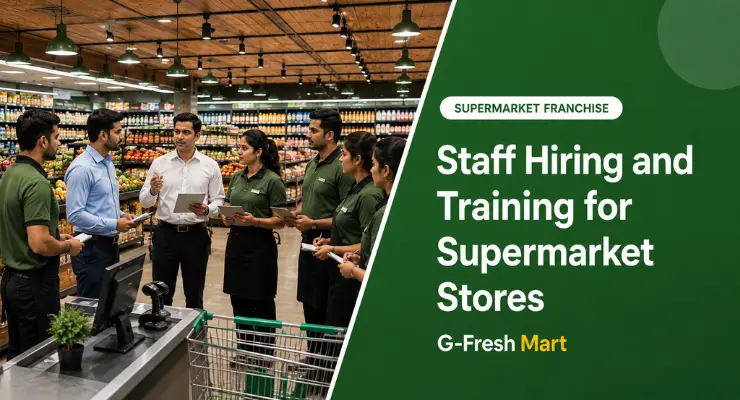
6. Hire and Train Your Store Team
Timeline: 2-3 weeks before opening
Your staff is the face of your store when you are not present. A poorly trained cashier can drive away a customer permanently. A well-trained floor staff member can upsell 20-30% more per customer visit. Hire and train before opening, not after.
Staffing Requirements by Store Format
| Role | Mini Mart (500-1,000 sq ft) | Super Mart (1,000-4,000 sq ft) | Hyper Mart (4,000-10,000 sq ft) |
| Store Manager | 1 (owner or senior staff) | 1 dedicated | 1-2 |
| Cashiers / Billing | 1-2 | 2-3 | 3-5 |
| Stock / Floor Staff | 1-2 | 2-4 | 4-8 |
| Customer Service | Combined with floor staff | 1 dedicated | 1-2 |
| Security | Optional (CCTV sufficient) | 1 if required | 1-2 |
| Total Staff | 3-5 people | 6-8 people | 10-17 people |
| Approx. Monthly Payroll | ₹45,000-₹75,000 | ₹90,000-₹1,50,000 | ₹2,00,000-₹3,50,000 |
Hiring Best Practices
- Hire local: Staff who speak the local language and understand the community’s shopping habits reduce friction with customers and earn trust faster. A familiar face behind the counter is worth more than a credential.
- Cross-train all staff: Every staff member should be able to handle billing, floor duties, and basic customer queries. Single-skill staff create bottlenecks during peak hours and leave you exposed on days off.
- Set clear KPIs from Day 1: Assign daily sales targets, shrinkage limits, and customer service expectations in writing. Staff who know what good performance looks like are more motivated and easier to manage.
- Performance incentives: A small monthly bonus (₹500-₹1,000) tied to store targets costs little but significantly reduces staff turnover – one of the biggest hidden costs in retail.
Training Programme
- Product knowledge: Staff must know which aisle stocks which category, the prices of the top 50 fast-moving SKUs, and which promotions are currently running. G-Fresh Mart provides a product training module as part of franchise onboarding.
- Billing system operation: All staff who handle the POS must be trained to process sales, apply discounts, handle returns, and print GST invoices before the store opens.
- Customer handling: Train staff to greet customers, assist with product location, handle complaints without escalation, and process exchange requests calmly. Role-play scenarios during training are more effective than instructions alone.
- Inventory and restocking: Teach stock clerks how to read the inventory management system, when to trigger reorders, and how to handle near-expiry products. Expiry management alone prevents thousands of rupees in monthly wastage.
7. Launch Your Store and Build a Loyal Customer Base
Timeline: Opening week and ongoing
Your first 30 days determine whether you build a loyal customer base or fight for every transaction. Execute a deliberate launch plan – not just a ‘we’re open’ sign.
Grand Opening Strategy
- Date selection: Open on a Friday or Saturday – high footfall days in most Indian cities. Avoid opening mid-week when footfall is lowest.
- Opening offers: Launch with 3-5 specific discounts on fast-moving items (cooking oil, biscuits, cold drinks, dairy) rather than generic ‘10% off everything’ promotions. Specific offers feel more credible and are talked about by neighbours.
- Local media: Advertise in local newspapers (regional editions) and use 100-200 flyers distributed in a 500-metre radius 3 days before opening. Include a first-visit discount voucher.
- WhatsApp broadcast: Build a WhatsApp group or broadcast list from Day 1. Announce offers, new arrivals, and seasonal promotions directly. This costs nothing and consistently drives repeat visits.
- Opening event: Invite a local known figure (RWA president, school principal, local politician) for the ribbon-cutting. Their presence drives neighbourhood curiosity and early footfall.
Ongoing Marketing That Actually Works in Indian Supermarkets
| Strategy | Cost | Impact | Frequency |
| WhatsApp offers broadcast | Zero | High – direct to existing customers | Weekly |
| Local flyer distribution | ₹2,000-₹5,000 per round | High for new customer acquisition | Monthly |
| Loyalty points programme | System cost only | Very High – drives repeat visits | Ongoing |
| Festival promotions (Diwali, Holi, Eid, etc.) | Margin on promotional stock | High – drives basket size | Per festival |
| Google Business Profile listing | Zero | High – local search discovery | One-time setup |
| Social media (Instagram, Facebook) | Zero (organic) or ₹500–₹2,000 (paid) | Medium – brand awareness | 3x per week |
| Newspaper inserts (local editions) | ₹3,000–₹8,000 per insert | Medium – older demographic | Quarterly |
What G-Fresh Mart Provides for Your Store Launch
- Premium store branding: Facade signage, internal gondola branding, and shelf strips in G-Fresh Mart’s distinctive yellow-and-green identity – all designed to create a recognisable, professional store appearance that builds customer trust from Day 1.
- Digital marketing support: G-Fresh Mart promotes franchise stores on its social media platforms – Instagram, Facebook, and YouTube – to support the launch and generate local awareness. No additional cost to the franchisee.
- Supply chain activation: Your store is connected to G-Fresh Mart’s network of 1,500+ brand partners before opening day, including Amul, Nestle, ITC, Britannia, HUL, Patanjali, and P&G. Products are available at bulk pricing from Day 1.
Check out this: Supermarket Franchise Cost in India: The Complete 2026 Breakdown
How to Monitor Your Supermarket Franchise Performance
Most franchise owners track daily sales but miss the metrics that actually predict whether the business is healthy. Track these five every week:
| KPI | What It Measures | Healthy Range | Action if Below Target |
| Daily Revenue | Total sales per day | Mini Mart: ₹15,000-₹25,000/day at maturity | Review product mix and promotions |
| Average Transaction Value | Revenue per customer visit | ₹280-₹450 for grocery supermarkets | Train staff on upselling, improve product placement |
| Inventory Turnover | How fast stock moves | Every 7-14 days for fast-moving goods | Identify slow-moving SKUs and replace them |
| Shrinkage Rate | Loss from theft, expiry, damage | Below 1.5% of revenue | Tighten expiry management, check CCTV footage weekly |
| Repeat Customer Rate | % of customers who return within 30 days | Target 60%+ by Month 3 | Loyalty programme, consistent product availability |
Scaling After Your First Store Stabilises
- Open a second outlet: Once your first store is profitable and operating with less than 2 hours of your daily involvement, it is ready to self-run. That frees your capacity to open a second location. Most G-Fresh Mart franchisees who open a second store do so within 18-24 months of the first.
- Introduce private label or exclusive SKUs: Work with your supplier relationships to stock items not available at nearby stores. Even 3-5 unique products create a ‘you can only get this here’ reason for customers to choose you.
- Add home delivery: A WhatsApp-based order-and-delivery service within a 2 km radius adds 10-20% to monthly revenue at minimal cost. One delivery staff member on a two-wheeler handles 15-25 orders per day.
Start Your G-Fresh Mart Franchise Application Today
G-Fresh Mart has helped 400+ entrepreneurs across 22 Indian states open their own supermarket franchise. The FOFO model means you own the business – the profits are yours.
The 45-day setup, zero royalty for 6 months, and a dedicated support team from site survey to opening day make it one of the most structured franchise entry processes in India’s grocery retail sector.
Two ways to take the next step:
Calculate your investment: Enter your target city and store size for a complete cost breakdown.
Apply for a franchise: Visit apply franchise to submit your application. A G-Fresh franchise advisor will call within 2 business days.
How much does it cost to start a supermarket franchise in India?
A supermarket franchise in India costs between ₹14 lakh and ₹2.5Cr depending on the brand and store format. G-Fresh Mart’s Mini Mart format starts at ₹14 lakh (including franchise fee of ₹2,10,000 + GST, billing software of ₹50,000 + GST, security deposit of ₹1,00,000, and initial stock and fit-out). Use the free calculator for a city-specific estimate.
Which supermarket franchise is best for first-time investors in India?
For first-time investors with ₹14-₹25 lakh capital, a FOFO model franchise like G-Fresh Mart’s Mini Mart format is typically the best starting point. It provides brand recognition, supply chain access, billing software, and training while limiting initial investment risk. The FOFO model means you own the store and keep all profits above your operating costs.
How long does it take to open a supermarket franchise in India?
The complete process – from initial inquiry to opening day – takes approximately 60-90 days. This includes site evaluation (1-2 weeks), documentation and franchise agreement (1-2 weeks), legal registrations (2-4 weeks, run in parallel), and store setup and fit-out (3-6 weeks). G-Fresh Mart’s 45-day setup timeline covers the period from site approval to opening day.
What licenses are required to open a supermarket in India?
A supermarket in India requires: Business Registration (proprietorship, partnership, LLP, or Pvt Ltd), GST Registration, FSSAI Food Safety License, Trade License from the Municipal Corporation, Establishment License (state labour department), and Shops & Establishments Act registration. Some states also require a Fire NOC for stores above a certain square footage. Processing time is typically 3-4 weeks when all applications are submitted simultaneously.
Is a supermarket franchise profitable in India?
Yes – supermarket franchises operating on a FOFO model in India generate gross margins of 18-25% on revenue. A well-managed G-Fresh Mart Mini Mart in a residential location generating ₹15,000-₹25,000 in daily revenue operates at 20-25% gross margin, with net profit after all costs of 8-12%. Most Mini Mart investments are recovered within 12-18 months in strong locations.
How do I apply for a G-Fresh Mart supermarket franchise?
Visit G-Fresh Mart Apply Franchise and fill in the application form with your name, contact details, target city, and preferred store format. A G-Fresh franchise advisor will call you within 2 business days to discuss your location, investment capacity, and next steps. There is no application fee.