
Quick Answer
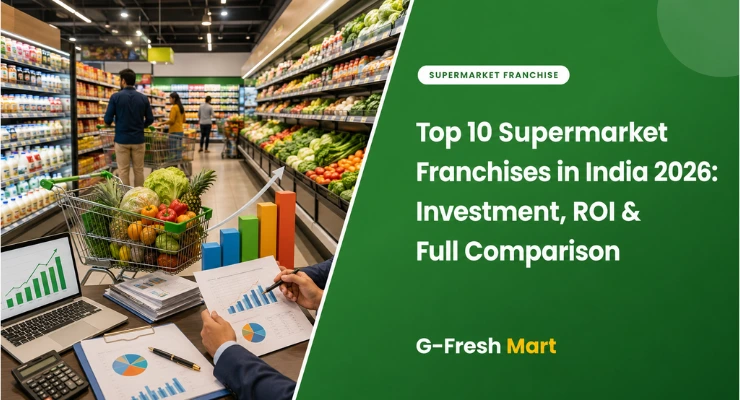
The top 10 supermarket franchises in India for 2026 are:
(1) G-Fresh Mart: ₹14L Investment, 400+ stores, 20-25% margins;
(2) BigDeal Supermart: ₹13-23L, 3 formats, no royalty;
(3) Reliance Fresh: ₹15-30L, 2,700+ stores;
(4) Spencer’s: ₹30-60L, premium metro;
(5) BigBasket: ₹20-30L, Tata-backed online/dark store;
(6) Retail Way: ₹10-25L, 20-30% ROI claim;
(7) 7xBasket: ₹13L+, 150+ partners, tech-focused;
(8) SuperK Supermarket: ₹20-25L, AI inventory, 5% royalty;
(9) Bestway Supermart: ₹10-20L, 18+ stores;
(10) Megamart Ventures: ₹10-15L, 100+ franchise outlets.
INTRODUCTION
India’s organised grocery retail market is growing at 10-12% per year, and the shift from kirana stores to modern supermarkets is accelerating across every city tier.
For entrepreneurs, this represents the best window in a generation to enter organised retail through a proven franchise model – with lower risk, established supply chains, and immediate brand recognition.
But choosing the right franchise brand from the growing number of options requires real data.
This guide evaluates the top 10 supermarket franchise brands in India for 2026 – with verified investment figures, profit margin data, store counts, and support quality for each brand.
Every detail is sourced from current brand information, third-party franchise directories, and real investor reports. Use this as your complete pre-investment reference.
Not sure where to start? Read 12 benefits of grocery franchise in India first for a full case for the franchise model over independent retail.
Master Comparison: Top 10 Supermarket Franchises in India 2026
| # | Brand | Investment | Stores (2026) | Gross Margin | Setup | Best For |
|---|---|---|---|---|---|---|
| 1 | G-Fresh Mart | ₹14L-₹90L | 400+ / 22 states | 20-25% | 45 days (guaranteed) | All tiers – proven multi-state |
| 2 | BigDeal Supermart | ₹13L-₹23L | Growing – Tier 2/3 | ~20% | 45 days | Low investment – 3 formats |
| 3 | Reliance Fresh | ₹15L-₹30L | 2,700+ stores | 15-25% | 90-120 days | Metro + Tier 1 – brand scale |
| 4 | Spencer’s Retail | ₹30L-₹60L | 120+ stores | 15-22% | 90-120 days | Metro premium + property partners |
| 5 | BigBasket | ₹20L-₹30L | Dark stores across cities | 10-15% | 30-45 days | Online grocery – delivery focus |
| 6 | Retail Way | ₹10L-₹25L | Growing – Tier 2/3 | 20-30% (claimed) | 30-45 days | Scalable grocery model |
| 7 | 7xBasket | ₹13L-₹62L | 150+ partners | ~20-25% | 45 days | Tech-driven – 3 formats |
| 8 | SuperK Supermarket | ₹20L-₹25L | Tier 2/3 focus | ~18-22% | 30 days | AI inventory – 5% royalty |
| 9 | Bestway Supermart | ₹10L-₹20L | 18+ stores (South India) | ~15-20% | 45 days | South India – growing network |
| 10 | Megamart Ventures | ₹10L-₹15L | 100+ outlets | ~15-20% | 45 days | Budget – hypermarket format |
Use our franchise investment calculator to model your exact ROI based on your city, format, and budget.
1. G-Fresh Mart – Best Overall Supermarket Franchise in India 2026
Why G-Fresh Mart Ranks #1
G-Fresh Mart is the only brand in this list that combines: ₹14 lakh accessibility, 400+ operational stores across 22+ states, 20-25% gross margins, 45-day contractual setup guarantee, 20,000+ product range, and a lifetime dedicated franchise manager – all at the same franchise fee. No royalty for the first 3 months. Free site survey. Free 3-month accounting. Award-winning brand (Best Startup FMCG – Right Choice Awards 2023).
| G-Fresh Mart – Complete Franchise Data | Details |
| Founded | 2017 |
| Franchising Commenced | 2021 |
| Total Operational Stores | 400+ across 250+ cities and 22+ states |
| Store Formats | Mini Mart (500-1,000 sq ft) | Super Mart (1,000-4,000 sq ft) | Hyper Mart (4,000–10,000 sq ft) |
| Starting Investment (Mini Mart) | ₹14 lakh – ₹25 lakh (all-inclusive) |
| Franchise Fee | ₹2,10,000 + GST (no premium by format – same across all three) |
| Software Fee | ₹50,000 + GST (cloud POS + real-time inventory – included in package) |
| Security Deposit | ₹1,00,000 (refundable on exit in good standing) |
| Royalty Fee | No royalty for first 3 months – transparent terms thereafter |
| Gross Profit Margin | 20-25% across product categories |
| Net Profit Margin | 10-20% at operational maturity |
| Investment Recovery | 12-24 months (Mini Mart) | 18-30 months (Super Mart) |
| Products Available | 20,000+ SKUs from 1,500+ national and international brands |
| Setup Timeline | 45 days – contractual guarantee from agreement signing |
| Free Site Survey | ✅ Included – population analysis, competitor audit, territory mapping |
| Accounting Support | Free for first 3 months post-opening |
| Marketing Support | National campaigns + local advertising materials + social media templates |
| Franchise Manager | Lifetime dedicated manager – not a helpdesk |
| Technology | Cloud-based POS + GST billing + real-time inventory + UPI/card/cash |
| Awards | Best Startup of the Year in FMCG – Right Choice Award 2023 (Brands Impact) |
| Website | gfreshmart.com |
G-Fresh Mart Investment Breakdown (Mini Mart)
| Cost Component | Amount |
| Franchise Fee | ₹2,10,000 + GST |
| Software Fee (Per Login ) | ₹50,000 + GST |
| Security Deposit (refundable) | ₹1,00,000 |
| Interior Cost | ₹6,00,000 |
| Purchasing Cost | ₹5,00,000 |
| TOTAL (Mini Mart) | ₹14 lakh – ₹25 lakh |
Full cost breakdown: Supermarket Franchise Cost in India 2026
Format details: Mini Supermarket Franchise in India
2. BigDeal Supermart – Best Low-Investment Option
| BigDeal Supermart – Key Details | Data |
| Founded | 2025 (franchising since 2025) |
| Store Formats | Mini Mart (500-1,000 sq ft) | Super Mart (1,000-4,000 sq ft) | Hyper Mart (4,000-10,000+ sq ft) |
| Investment | ₹13-23L (Mini Mart) | ₹23-83L (Super Mart) | ₹83-2.2CR (Hyper Mart) |
| Royalty Fee | Claims 0% royalty – 100% profit retention for franchisees |
| Profit Margin | ~15-20% gross | ~₹2,00,000/month claimed at operational maturity |
| Setup Timeline | 45 days claimed |
| Store Count | Growing – Tier 2/3 cities – limited independent verification available |
| Products Available | FMCG, grocery, dairy, beverages, personal care, packaged foods |
| Technology | Billing software + backend systems – included in franchise package |
| Best For | First-time investors seeking lowest entry point with no-royalty model |
| Website | bigdealsupermart.com |
BigDeal Supermart is an emerging brand specifically targeting low-investment entrepreneurs in Tier 2 and Tier 3 cities.
Its zero-royalty model is a genuine differentiator – franchisees retain 100% of store profits.
The brand offers three formats that mirror G-Fresh Mart’s Mini/Super/Hyper structure, with investment starting at ₹14 lakh for the smallest format.
Investor Note on BigDeal Supermart
BigDeal Supermart’s zero-royalty model and low entry point make it attractive, but the brand’s store count and geographic reach are significantly smaller than G-Fresh Mart’s 400+ store network. Before investing, visit existing operational stores and verify current franchisee experience directly. Ask specifically about supply chain reliability, product range depth, and technology support responsiveness.
3. Reliance Fresh – Largest Brand Network, High Investment
| Reliance Fresh – Key Details | Data |
| Parent Company | Reliance Retail (Reliance Industries Limited) |
| Founded | 2006 |
| Store Count | 2,700+ stores across India (mix of company-owned and franchise) |
| Investment Range | ₹15 lakh – ₹30 lakh |
| Franchise Fee | ₹20 lakh – ₹35 lakh range |
| Gross Profit Margin | 15–25% |
| Setup Timeline | 90-120 days typical |
| Product Range | Full FMCG, fresh produce, dairy, household – extensive |
| Best For | Metro and Tier 1 city investors with strong capital and prime location |
| Website | relianceretail.com |
Reliance Fresh is backed by Reliance Retail – India’s largest retail company. The brand’s national scale and supply chain depth are unmatched.
However, the franchise model primarily favours investors in metro cities with significant capital and prime commercial locations. Entry costs are substantially higher than emerging franchise brands.
G-Fresh Mart vs Reliance Fresh
Reliance Fresh requires ₹20-35L in franchise fee alone – before fit-out or inventory. G-Fresh Mart’s total all-inclusive investment starts at ₹14L. For Tier 2/3 city investors or those with budgets under ₹30L, G-Fresh Mart delivers equivalent organised retail credibility at a fraction of the cost.
4. Spencer’s Retail – Premium Metro Franchise
| Spencer’s Retail – Key Details | Data |
| Founded | 1962 (one of India’s oldest retail brands) |
| Store Count | 120+ stores |
| Investment Range | ₹30 lakh – ₹60 lakh |
| Franchise Fee | ₹5 lakh |
| Gross Profit Margin | 15–22% |
| Setup Timeline | 90-120 days |
| Partnership Models | Franchise | Distributorship | Property Partner (revenue sharing for space owners) |
| Best For | Premium metro locations | Investors with prime property assets |
| Website | spencersretail.com |
Spencer’s has a strong heritage brand identity, especially in East India, and operates in both supermarket and hypermarket formats.
The brand is particularly relevant for investors who own prime commercial property – their Property Partner model allows revenue sharing for space owners.
Investment requirements are higher than most emerging franchise brands.
G-Fresh Mart vs Spencer’s
Spencer’s requires ₹30-60L and operates primarily in metros. G-Fresh Mart starts at ₹14L, is operational in 22+ states including Tier 2/3 markets, and delivers 20-25% gross margins vs Spencer’s 15-22%. G-Fresh Mart is the better choice for investors outside the top 6 metros.
5. BigBasket (Tata Group) – Online Grocery / Dark Store Model
| BigBasket – Key Details | Data |
| Founded | 2011 |
| Parent Company | Tata Digital (acquired 2021) |
| Model | Online grocery + dark store (fulfilment centre – not walk-in retail) |
| Investment Range | ₹20 lakh – ₹30 lakh |
| Profit / Commission | 8-15% commission on net sales (not ownership model) |
| ROI Timeline | ~1 year (from franchise directory data) |
| Best For | Tech-oriented investors who want e-commerce grocery revenue – not physical retail |
| Key Advantage | Tata brand trust + massive online customer base + strong supply chain |
| Key Difference | Dark store – no walk-in customers – pure fulfilment facility |
| Website | bigbasket.com |
BigBasket is fundamentally different from the other brands on this list. It is not a walk-in supermarket franchise – it is an online grocery platform with dark store and distribution point models.
Investors partner with BigBasket to operate fulfilment facilities that fulfil digital orders rather than serving walk-in customers.
This is a completely different business model from a physical supermarket franchise.
Important: BigBasket Is Not a Physical Supermarket Franchise
If your goal is to operate a walk-in neighbourhood supermarket serving daily customers, BigBasket is not the right choice – it is an e-commerce fulfilment model. If your goal is to participate in online grocery delivery through a Tata-backed platform, BigBasket’s dark store model is worth evaluating.
6. Retail Way – Scalable Grocery Franchise with Low Entry
| Retail Way – Key Details | Data |
| Headquarters | India – Tier 2/3 city focus |
| Investment Range | ₹10 lakh – ₹25 lakh |
| ROI Claimed | 20-30% ROI (per brand website) |
| Setup Timeline | 30-45 days claimed |
| Product Range | 20,000+ products (per brand claim) |
| Support | Store design, supply chain, inventory software, staff training, local branding |
| Best For | Entrepreneurs seeking scalable grocery model – Tier 2/3 markets |
| Royalty | Not publicly specified – verify directly |
| Website | retailsway.com |
Retail Way positions itself as a scalable grocery franchise model for Tier 2 and Tier 3 city entrepreneurs.
The brand emphasises its ready-to-launch store model, supply chain access, and ongoing business advisory support.
GHH Investment entry is competitive and the brand has been covered in industry franchise guides for 2026.
Investor Note on Retail Way
Retail Way’s store count and verified franchisee network are smaller than established players. Before investing, request current franchisee references and verify the 20,000+ product claim independently. Ask specifically about supply chain delivery frequency and technology support infrastructure.
7. 7xBasket – Tech-Driven Franchise with Three Store Formats
| 7xBasket — Key Details | Data |
| Founded | 2022 (franchising commenced 2022/2023) |
| Franchise Partners | 150+ across India |
| Store Formats | Mini Store (500-1,000 sq ft, ₹13L) | Super Store (₹23L-₹62L) | Hyper Store (₹63L-₹2Cr) |
| No Royalty | First 2 months – no royalty (claimed) |
| Profit Margin | ~20–25% claimed |
| Setup Timeline | 45 days claimed |
| Technology | Cloud-based inventory management – highlighted as key differentiator |
| Best For | Tech-oriented investors – Tier 2/3 cities |
| Contact | Phone: +91 9870275327 |
| Website | 7xbasket.com |
7xBasket is a relatively new entrant that differentiates primarily on technology – emphasising its cloud-based inventory software and data-driven store management approach.
The brand has grown to 150+ franchise partners and offers competitive investment from ₹13 lakh for the Mini Store format.
G-Fresh Mart vs 7xBasket
G-Fresh Mart has 400+ stores vs 7xBasket’s 150+ partners – a significant difference in proven track record across diverse markets. Both brands offer cloud-based billing software. G-Fresh Mart’s 20,000+ product range vs 7xBasket’s unspecified range is a key differentiation point. G-Fresh Mart also provides a contractual 45-day guarantee vs 7xBasket’s claimed timeline.
8. SuperK Supermarket – AI-Powered Grocery Franchise
| SuperK Supermarket – Key Details | Data |
| Founded | 2019 (franchising commenced 2019) |
| Model | Tech-enabled franchise – AI inventory management + centralised procurement |
| Total Investment | ₹20 lakh – ₹25 lakh |
| Franchise Fee | ₹10 lakh – ₹14 lakh |
| Royalty Fee | 5% royalty + 2% marketing fee (ongoing) |
| Initial Inventory | ~₹8 lakh |
| Setup Timeline | 30 days claimed |
| Target Market | Tier 2 and Tier 3 cities – existing kirana upgraders |
| Technology Differentiator | AI-driven demand forecasting + automated inventory management |
| Website | superk.in |
SuperK positions itself as a full-stack technology solution for small-format grocery retail in Tier 2 and Tier 3 cities.
The brand’s AI-driven inventory and centralised procurement model is designed to help store owners – including kirana operators upgrading to organised retail – manage operations more efficiently.
Investor Note: SuperK’s 5% Royalty
SuperK charges a 5% ongoing royalty plus a 2% marketing fee – totalling 7% of revenue on an ongoing basis. At a monthly revenue of ₹8 lakh, this is ₹56,000/month in fees. Factor this into your P&L model before comparing with no-royalty brands like G-Fresh Mart (first 3 months) and BigDeal Supermart.
9. Bestway Supermart – Growing South India Franchise
| Bestway Supermart – Key Details | Data |
| Parent Company | Blueville Retails Private Limited |
| Store Count | 18+ outlets (primarily South India – expanding to North India) |
| Store Size | 500 sq ft – 5,000 sq ft |
| Investment Range | ₹10 lakh – ₹20 lakh (estimated – verify directly) |
| Product Range | Groceries, household essentials, personal care |
| Setup Timeline | 45 days claimed |
| Geographic Strength | South India – Tamil Nadu, Andhra, Karnataka regions |
| Best For | South India investors seeking regional brand with growing network |
| Website | bestwaysupermart.com |
Bestway Supermart (operated by Blueville Retails Private Limited) is a growing supermarket franchise brand with its primary strength in South India.
The brand has 18+ operational outlets and is actively expanding into North India.
For investors in South Indian markets seeking a regional brand with local market understanding, Bestway Supermart is worth evaluating.
Investor Note on Bestway Supermart
With 18+ stores, Bestway is significantly smaller than G-Fresh Mart’s 400+ network. This means less supply chain leverage and less proven geographic diversity. For South India investors specifically, the brand’s regional knowledge may be an advantage. Always visit existing stores before committing.
10. Megamart Ventures – Budget-Entry Hypermarket Franchise
| Megamart Ventures – Key Details | Data |
| Founded | 2020 |
| Franchising Commenced | 2021 |
| Store Count | 100+ franchise outlets (per franchise directory data) |
| Investment Range | ₹10 lakh – ₹15 lakh |
| Product Range | 5,000+ SKUs from 200+ national and regional brands |
| Format | Hypermarket format – FMCG, groceries, apparel, impulse categories |
| Best For | Budget investors seeking hypermarket format at low entry |
| Website | megamartventures.com |
Megamart Ventures offers a hypermarket franchise format at an unusually low ₹10-15 lakh investment entry point.
The brand has grown to 100+ franchise outlets and operates across multiple Indian states.
Product range of 5,000+ SKUs is more limited than G-Fresh Mart’s 20,000+, but the low investment makes it accessible to first-time investors.
G-Fresh Mart vs Megamart Ventures
G-Fresh Mart’s 20,000+ SKU range is 4x larger than Megamart’s 5,000+, which directly impacts basket size and revenue potential. G-Fresh Mart’s franchise fee is documented and transparent. Both brands have 100+ stores as a scale reference point – however, G-Fresh Mart’s 400+ is a stronger proof base.
Why 2026 Is the Best Year to Start a Supermarket Franchise in India
Three structural forces are converging in 2026 that make organised grocery franchise investment more attractive than any prior year:
| Driver | 2026 Status | Franchise Investor Impact |
| Organised retail penetration | ~12% currently – growing toward 30% by 2030 | Massive whitespace – most of India is still unserved by organised retail |
| Tier 2/3 city income growth | 8-12% annual retail growth in smaller cities | First-mover advantage available in hundreds of cities |
| UPI + digital payment adoption | 700M+ UPI users – 50%+ of retail transactions digital | Franchise billing systems already prepared – no infrastructure gap |
| FMCG market expansion | ₹5.5 lakh crore FMCG – growing 10% annually | Strong product supply at improving margins for franchise owners |
| Kirana to supermarket shift | Consumers switching to organised retail consistently | Built-in customer base shift toward your format |
How to Choose the Right Supermarket Franchise From This List
Before committing to any brand on this list, complete this 10-point checklist. Read our full guide: 10 critical things to check before buying a supermarket franchise
- Store count verification: Visit 2+ physical stores – confirm operational, branded, well-run
- Complete investment breakdown in writing: Every cost component itemised – no vague ‘all-inclusive’ figures
- Territory exclusivity documented: Written in franchise agreement – not verbal promise
- Royalty structure clarity: Ongoing royalty % of revenue vs profit vs fixed fee – model your P&L at each royalty level
- Actual ROI data from franchisees: Request real P&L from 2-3 existing stores – not brand projections
- Technology demo: Test billing software live – GST compliance, offline mode, UPI all verified
- Supply chain verification: How many brands, what delivery frequency, what backup for stockouts?
- Product range count: 5,000 SKUs vs 20,000 SKUs is a 4x difference in basket size potential
- Franchise agreement legal review: Have a lawyer review exit clauses, royalty escalation, renewal terms
- Setup guarantee: Is the 45-day timeline contractual (like G-Fresh Mart) or just a target?
Step-by-Step: How to Start a G-Fresh Mart Supermarket Franchise
If G-Fresh Mart is your choice – and the data in this guide strongly supports that – here is the complete 45-day process. Full guide: How to Start a Supermarket Franchise in India
| Step | Action | Day / Timeline |
| 1 | Apply at gfreshmart.com/franchise—consultation call within 24 hours | Day 1 |
| 2 | Shortlist 2–3 locations in your target city | Day 1-7 |
| 3 | Site survey by G-Fresh territory team – population audit, competitor map, territory approval | Day 7-14 |
| 4 | Sign franchise agreement – legal team support included | Day 14-18 |
| 5 | Pay franchise fee (₹2,10,000 + GST), software fee (₹50,000 + GST), security deposit (₹1,00,000) | Day 15-18 |
| 6 | Licence applications begin – FSSAI, GST, Trade Licence, Shop Act – G-Fresh guides all | Day 14-21 |
| 7 | Store interior fit-out following G-Fresh layout plan | Week 2-5 |
| 8 | Billing software installation + staff training by G-Fresh tech team | Week 4-5 |
| 9 | Initial inventory procurement via G-Fresh supply chain | Week 5-6 |
| 10 | Pre-launch walkthrough + grand opening – Day 45 guaranteed | Day 45 |
Frequently Asked Questions
Which is the best supermarket franchise in India in 2026?
G-Fresh Mart is the best supermarket franchise in India for 2026 for new investors – offering the lowest meaningful investment (₹14 lakh), the most proven geographic scale (400+ stores, 22+ states), the highest gross margins (20-25%), and the most comprehensive support package (free site survey, cloud POS, lifetime franchise manager, free 3-month accounting). No competing brand on this list simultaneously delivers all five of these advantages.
How much investment is needed to start a top supermarket franchise in India?
Investment varies significantly by brand. G-Fresh Mart Mini Mart: ₹14-25 lakh (all-inclusive). BigDeal Supermart: ₹10-25L. Reliance Fresh: ₹15-30L. 7xBasket Mini: ₹13L+. SuperK: ₹20-25L. BigBasket dark store: ₹20-30L. Spencer’s: ₹30-60L. Most first-time investors with ₹15-25 lakh budget will find G-Fresh Mart or BigDeal Supermart the most viable options in terms of investment-to-returns ratio.
Which supermarket franchise has the best ROI in India?
G-Fresh Mart consistently delivers the best ROI per rupee of investment, with Mini Mart franchisees recovering total investment within 12-24 months and achieving gross margins of 20-25%. The combination of low investment, high product range (20,000+ SKUs), no royalty for the first 3 months, and proven operational systems across 400+ stores makes it the most capital-efficient franchise on this list.
Is BigDeal Supermart better than G-Fresh Mart?
BigDeal Supermart has a lower investment (₹10L vs G-Fresh Mart’s ₹14L) and a zero-royalty model which are genuine advantages. However, G-Fresh Mart has 400+ operational stores vs BigDeal’s significantly smaller network, a 20,000+ SKU product range vs BigDeal’s unspecified range, and a longer proven track record across diverse Indian markets. For investors who prioritise proven scale and supply chain depth, G-Fresh Mart is the stronger choice. For investors who prioritise minimum entry cost and no-royalty structure, BigDeal Supermart is worth evaluating further.
Which supermarket franchise is best for Tier 2 cities in India?
G-Fresh Mart is the best supermarket franchise for Tier 2 and Tier 3 cities – proven across 22+ states with lower rent economics, less competition, and strong consumer demand for organised retail. 7xBasket and Retail Way also specifically target Tier 2/3 markets. BigDeal Supermart and Megamart Ventures are also positioned for these markets at lower investment levels.
What documents and licences are needed to open a supermarket franchise?
Required licences include FSSAI, GST Registration, Trade Licence, Shop & Establishment Licence, and Business Registration. Total cost: ₹10,000-₹20,000. G-Fresh Mart guides all licence applications as part of franchise onboarding. Full checklist: 10 things to check before buying a supermarket franchise
How long does it take to open a supermarket franchise in India?
Setup timelines vary significantly. G-Fresh Mart offers a contractual 45-day guarantee – the only brand on this list with a legally documented opening deadline. 7xBasket, BigDeal, Retail Way, and SuperK all claim 30-45 days. Reliance Fresh and Spencer’s typically require 90-120 days due to larger format and corporate approval processes. BigBasket dark stores can be operational in 30-45 days but are fulfilment facilities, not retail stores.
What is the profit margin in supermarket franchises in India?
Gross profit margins across Indian supermarket franchises range from 10-25% depending on brand, product mix, and location. G-Fresh Mart achieves 20-25% gross margins and 10-20% net margins at operational maturity. BigDeal and 7xBasket claim ~20% margins. BigBasket partners earn 8-15% commission on net sales. SuperK franchisees pay 7% in royalty and marketing fees which reduces effective net margins. Always verify actual P&L data from existing franchisees before making your investment decision.