
Quick Answer
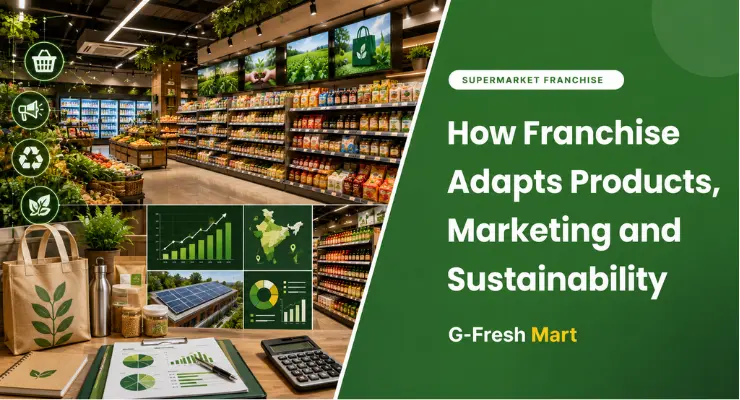
Supermarket franchises adapt their product lines and marketing strategies to different regions through 6 key approaches: local market research, product customisation to match regional demand, localisation of content and messaging, relevant regional communication, local partnerships with community networks, and data-driven continuous optimisation. Simultaneously, the most successful franchise networks are integrating eco-friendly practices – sustainable sourcing, waste reduction, energy efficiency, eco-friendly packaging, and green store design – for 10 documented business reasons including consumer demand, cost savings, regulatory compliance, and competitive differentiation. Both strategies are available to G-Fresh Mart franchise owners through the brand’s 1,500+ supplier network and operational support system.
Introduction
A franchise that works in Mumbai does not automatically work in a town in Rajasthan. A product range that sells well in a high-income metro colony performs differently in a Tier 3 town market.
A marketing message that connects with one demographic misses another entirely. The question of how franchise businesses adapt to serve diverse local markets is not a theoretical one – it directly determines whether a store in a new location succeeds or underperforms against its potential.
This guide covers two interconnected dimensions of how modern supermarket franchises evolve to meet the expectations of their markets.
Part 1 covers the adaptation of product lines and marketing strategies – the tactical decisions that make a franchise relevant in a specific location rather than generic.
Part 2 covers the adoption of eco-friendly practices – the operational decisions that are reshaping how franchise networks run their supply chains, stores, and packaging in response to consumer expectations and regulatory pressure.
Both dimensions apply directly to G-Fresh Mart franchise owners across India’s diverse regional markets.
Also Read: G-Fresh Mart Supermarket Franchise: Your Complete Guide
PART 1
How Supermarket Franchises Adapt Product Lines and Marketing Strategies
Localisation – the process of customising a franchise’s products, messaging, and marketing approach to fit the specific cultural and regional context of a target market – is one of the most important disciplines in franchise management.
It is what separates a franchise that gains genuine community acceptance from one that is perceived as a generic, out-of-touch brand.
In India’s diverse grocery market, localisation matters more than in almost any other consumer category.
Food preferences, language, festival cycles, household income, and brand loyalty vary significantly between states, between urban and rural areas, and even between neighbourhoods in the same city.
A supermarket franchise owner who understands their specific catchment and makes product and marketing decisions accordingly consistently outperforms one who applies a one-size-fits-all approach from a national playbook.
1. Why Product and Marketing Adaptation Matters in Indian Grocery
India is not a single market – it is thirty-six distinct consumer markets with different languages, culinary traditions, festival calendars, income profiles, and brand relationships.
What this means for a supermarket franchise owner is that the decisions made at the brand level – national product catalogue, national marketing campaigns, brand standards – are necessary but not sufficient for local success.
The additional layer of locally informed decisions is what determines whether a franchise store builds genuine customer loyalty or merely transactional footfall.
The Three Layers of Franchise Marketing in India
| Layer | Who Manages It | What It Includes | Impact |
| National brand marketing | Franchisor (G-Fresh Mart) | Social media campaigns, PR, brand consistency, digital presence | Builds brand awareness nationally; drives discovery for all stores |
| Regional brand marketing | Franchisor in coordination with franchise owners | Regional promotions, state-specific festival campaigns, geo-targeted digital ads | Ensures brand messaging is relevant to regional context |
| Local store marketing | Individual franchise owner | WhatsApp broadcasts, Google Business Profile, community engagement, local flyer distribution | Drives repeat visits and word-of-mouth for your specific store |
The franchise owner’s role is at the third layer – where the national brand becomes a local relationship. A G-Fresh Mart franchise in a residential colony in Lucknow and a G-Fresh Mart franchise in a market lane in Coimbatore share the same brand, the same billing software, and the same supplier network. What determines whether each becomes the preferred grocery destination for its specific neighbourhood is the quality of the owner’s local product decisions and local marketing activity.
2. Six Adaptation Strategies for Supermarket Franchise Owners
The following six strategies are how experienced supermarket franchise owners adapt their product lines and marketing to their specific local market – and how G-Fresh Mart’s franchise system supports each one.
Strategy 1: Local Market Research Before and After Opening
Local market research is not a one-time activity done before opening – it is an ongoing discipline that the best-performing franchise owners run continuously.
Before opening, the goal is to understand the catchment: what households exist within 1.5 km, what their income level and family composition is, what their current grocery shopping habits are, and what is missing in the current supply of grocery options.
After opening, the most valuable market research comes from your own POS data. Which products are selling fastest? Which are sitting unsold after 30 days? What time of day is your peak footfall? Which day of the week drives the highest basket size?
These data points tell you more about your specific local market than any general survey, because they reflect what your actual customers are actually doing – not what a representative sample says they might do.
G-Fresh Mart: G-Fresh Mart’s cloud POS auto-generates daily and weekly sales reports by SKU. Running these reports weekly – not monthly – gives franchise owners the fastest feedback loop on what their specific local market is responding to.
Strategy 2: Product Range Customisation to Local Demand
G-Fresh Mart’s 20,000+ SKU catalogue gives franchise owners access to a wide range of products – but not every store needs to stock every available SKU.
The most effective product strategy is to stock the full range of high-velocity staples (atta, rice, cooking oil, milk, basic personal care) that every household needs, then customise the secondary product range to match the specific preferences of your local customer base.
A franchise in a predominantly Gujarati residential colony might stock a wider range of snack and farsan products than a national average mix.
A franchise near a college or working-professional cluster might stock a wider range of instant foods and convenience items.
A franchise in a locality with a strong health-conscious consumer base might expand the organic and protein-rich category significantly beyond the standard range.
None of these customisations require a different supply chain – they require knowing your customers well enough to make informed SKU selection decisions.
G-Fresh Mart: The 1,500+ brand partnerships in G-Fresh Mart’s supplier network include regional brands as well as national ones – giving franchise owners the ability to stock locally preferred brands in categories where regional loyalty is strong, rather than being limited to a national-only product mix.
Strategy 3: Localisation of Marketing Content and Communication
Marketing content that speaks to a specific regional audience performs significantly better than generic national messaging.
This applies to the language used (Hindi, Tamil, Telugu, Marathi, Kannada – whatever your local customer base responds to), the cultural references included (festivals, local events, seasonal traditions), and the tone of communication (formal vs familiar varies significantly between North and South India, and between metro and small-town audiences).
A WhatsApp broadcast to customers in a Tamil-speaking area written in Tamil with references to Pongal is not just more considerate than a Hindi-language generic promotion – it is materially more effective at driving store visits.
Language and cultural familiarity build trust, and trust drives the repeat purchase behaviour that is the foundation of a profitable neighbourhood grocery franchise.
G-Fresh Mart: G-Fresh Mart’s digital and offline marketing materials can be adapted to regional language requirements by the individual franchise owner for their local customer base. The brand’s national messaging sets the framework; local language adaptation is the franchise owner’s opportunity to build genuine community connection.
Strategy 4: Festival and Seasonal Product and Marketing Alignment
India’s festival calendar varies significantly by region. Diwali is a national festival; Pongal is celebrated across Tamil Nadu and parts of Karnataka and Andhra Pradesh; Onam centres on Kerala; Bihu is celebrated in Assam; Eid follows a different regional intensity pattern across states.
A supermarket franchise owner who plans their product stocking and promotional activity around their specific local festival calendar captures festival-season demand that a generic national promotional calendar misses.
Festival-season planning should begin 3-4 weeks before the festival. Stock levels on gifting categories (dry fruits, premium snacks, packaged sweets) should be increased based on the previous year’s or comparable-market data.
Promotional signage should reflect the specific festival rather than generic seasonal messaging. WhatsApp broadcasts in the week before the festival should be direct and specific about what is available.
G-Fresh Mart: G-Fresh Mart’s supply network includes the full range of festival-season products across FMCG brand partners. Ordering festival stock 3 weeks in advance through the standard procurement channel gives franchise owners the best combination of availability and pricing.
Strategy 5: Local Community Partnerships and Engagement
No national franchise brand can build local community relationships on behalf of an individual store owner – that is inherently local work.
The franchise owners who build the strongest customer loyalty in their specific neighbourhood are those who treat their store as a community institution rather than a commercial outlet.
This means participating in local events, being present in housing society (RWA) communication channels, handling complaints personally, and building genuine personal relationships with regular customers.
Local partnerships extend this beyond individual relationships: a collaboration with a nearby school for stationery promotions during exam season, a relationship with a local gym for health-product promotions, a presence in the neighbourhood’s WhatsApp community group – each builds the store’s local identity in a way that no national campaign replicates.
G-Fresh Mart: G-Fresh Mart’s branding standards and store presence give franchise owners a credible anchor for local community engagement – customers trust the brand, and the franchise owner builds on that trust through personal local activity.
Strategy 6: Data-Driven Continuous Optimisation
The most reliable source of insight about what works in a specific franchise location is the store’s own transaction data.
Weekly POS reports reveal which products drive the most revenue, which categories carry the best margin, which time windows see the highest footfall, and which promotions actually drove basket size increases versus which ones discounted revenue without generating incremental volume.
The franchise owner who reviews their POS reports weekly and makes at least one specific operational adjustment based on what the data shows- reordering a fast-selling product, removing a slow-moving one, shifting a product’s shelf position to test whether visibility improves movement – will consistently outperform one who treats the billing system as data-only for tax compliance purposes. Every week’s data is a feedback loop; acting on it is the competitive advantage.
G-Fresh Mart: G-Fresh Mart’s cloud POS generates all of these reports automatically. The operational discipline is scheduling a weekly 30-minute data review and treating it as non-negotiable – the same way experienced retail operators treat daily cash reconciliation.
PART 2
How Supermarket Franchises Are Adopting Eco-Friendly Practices
The adoption of eco-friendly practices in franchise businesses is no longer a niche strategic choice – it is becoming a mainstream operational expectation driven by consumer demand, regulatory pressure, cost economics, and competitive differentiation.
For supermarket franchises specifically, which deal with large volumes of packaged goods, significant energy consumption in refrigeration, and ongoing food waste challenges, the practical case for sustainability is both environmental and financial.
3. Why Supermarket Franchises Are Adopting Eco-Friendly Practices: 10 Reasons
Understanding why franchise businesses are making sustainability investments clarifies which practices are most relevant for a specific store’s market and operational context.
1. Consumer Demand and Shifting Purchase Preferences
Consumers are increasingly choosing brands that visibly align with environmental values. This trend is most pronounced in urban markets and among younger demographics – but is spreading steadily to Tier 2 cities and older consumer segments.
A store that is visibly reducing plastic use, offering reusable bag incentives, and communicating its sustainability practices builds a brand attribute that resonates with this growing consumer segment.
2. Cost Savings Through Operational Efficiency
Many eco-friendly practices generate direct cost savings. Energy-efficient refrigeration and LED lighting reduce monthly electricity bills – often the second or third largest overhead after rent for a supermarket franchise.
Waste reduction programmes reduce disposal costs. Reduced packaging decreases supplier-side cost when negotiated. These are not abstract environmental benefits – they appear on the monthly P&L as real cost reductions.
3. Regulatory Compliance and Risk Management
India’s regulatory environment for plastic use, food waste, and environmental standards has become steadily more stringent. The Plastic Waste Management Rules restrict certain single-use plastics.
State-level food safety regulations increasingly cover waste management practices in retail food stores. Franchises that build sustainable operations proactively stay ahead of compliance requirements rather than reacting to enforcement.
4. Enhanced Brand Image and Reputation
Sustainability commitments differentiate a franchise from competitors who have not yet made the same visible investments.
In a neighbourhood market where two or three grocery stores compete for the same customer base, a store that is visibly eco-conscious – through packaging choices, in-store communications, and community engagement on environmental topics – builds a brand attribute that price-only competitors cannot match.
5. Employee Engagement and Talent Retention
Staff who work for an employer with visible values – including environmental responsibility – report higher job satisfaction and lower turnover intention.
For a grocery franchise where staff turnover is one of the most consistent operational costs (retraining is expensive and service quality dips during transition periods), any practice that improves staff retention has a direct positive impact on net operating cost.
6. Competitive Differentiation in Local Market
A neighbourhood grocery franchise that is known locally for sustainable practices has a genuine point of differentiation.
When a customer is choosing between two similarly located and similarly priced grocery stores, the one that visibly cares about its community and environment consistently earns the higher loyalty.
This differentiation compounds over time – it is not easily copied by a competitor who has built a reputation for treating sustainability as an afterthought.
7. Long-Term Supply Chain Resilience
Supply chains that rely heavily on non-renewable resources or single-source suppliers are more vulnerable to disruption than those built on diverse, sustainable sourcing.
Franchises that engage with suppliers committed to sustainable practices – reducing packaging, using recycled materials, optimising logistics to reduce carbon emissions – build supply chains that are more resilient to both regulatory changes and resource cost volatility.
8. Corporate Social Responsibility and Community Standing
Franchises that invest in community-visible sustainability initiatives – sponsoring local clean-up events, partnering with schools on environmental education, donating near-expiry food to local charities rather than discarding it – build a standing in their local community that goes beyond transactional. They become local institutions rather than retail outlets.
9. Innovation Driving New Operational Opportunities
Sustainability-focused innovation regularly surfaces operational improvements that have both environmental and financial benefits.
Digital receipts that reduce paper waste also save consumable costs. Reusable crate systems for produce delivery reduce packaging cost.
Energy monitoring systems that track consumption in real time identify waste that manual monitoring misses. Each innovation compounds the others.
10. Future-Proofing Against Market and Regulatory Change
Consumer preferences and regulatory requirements are both moving steadily in the direction of greater environmental accountability.
Franchises that begin building sustainable operations now are positioning themselves ahead of the market shift rather than reacting to it after competitors have already established a sustainability-based differentiation.
The cost of early adoption is lower than the cost of reactive change later.
Check out this: How to Open a Grocery Supermarket in India (2026 Guide)
4. Five Eco-Friendly Practices Supermarket Franchises Can Implement
| Practice | What It Involves | Benefit | Franchise Cost |
| Sustainable sourcing | Prioritising suppliers with lower packaging and local sourcing where available; supporting products with environmental certifications | Reduces carbon footprint; aligns with consumer preference for local and natural products | Minimal – SKU selection within existing catalogue |
| Waste reduction and recycling | Near-expiry clearance sections; staff training on FIFO to reduce spoilage; segregated waste disposal; food donation programmes | Reduces disposal cost; improves margin by clearing stock before write-off | Low – process and training cost only |
| Energy efficiency | LED lighting throughout; regular refrigeration maintenance; energy monitoring; switching off non-essential equipment during off-peak hours | Reduces electricity bill by 20–30%; lower carbon emissions | Low-moderate – LED upgrade is one-time cost with rapid payback |
| Sustainable packaging | Charging for single-use carry bags; offering reusable alternatives; encouraging customers to bring their own containers; reducing in-store plastic in displays | Reduces plastic waste; complies with Plastic Waste Management Rules; improves brand image | Low – primarily process and policy change |
| Eco-friendly store operations | Implementing green practices in store design and operation: natural lighting where possible, energy-efficient POS hardware, responsible chemical use in cleaning | Contributes to reduced environmental footprint; supports brand reputation | Varies – can be incorporated in next fit-out cycle |
5. Challenges in Adapting and Going Green – and How to Manage Them
- Initial investment requirement: Some sustainability investments (solar panels, LED upgrades, energy-efficient refrigeration) require upfront capital. Prioritise the changes with the fastest financial payback – LED lighting and refrigeration maintenance typically pay back within 12 months through electricity bill reduction.
- Consistency across a store network: For a franchise network, ensuring every store adopts the same sustainability standards requires clear operational guidelines from the franchisor and regular audits. Individual franchise owners should treat their own store’s compliance as a baseline, not a ceiling.
- Customer education on eco practices: Some sustainability changes – charging for carry bags, encouraging customers to bring reusable containers, explaining near-expiry clearance pricing – require active customer communication. In-store signage, WhatsApp broadcast explanations, and staff scripting help customers understand and accept the change.
- Supplier compliance: Not every supplier in a franchise’s network will immediately offer sustainable packaging or certified ethical sourcing. Within a franchise catalogue, prioritise the sustainable options where they exist; communicate preference for sustainability to the franchise operations team for inclusion in future supplier negotiations.
How G-Fresh Mart Franchise Owners Apply Both Strategies
Adapting product lines and marketing strategies to local markets, and building eco-friendly store operations, are not separate strategic programmes – they are both part of how a well-run supermarket franchise becomes genuinely embedded in its community rather than simply present in it.
A store that stocks the products its neighbourhood actually wants, communicates in ways that resonate with its specific customers, and operates in a way that reflects the values its community cares about, builds the kind of customer loyalty that is the foundation of long-term profitability.
G-Fresh Mart’s 20,000+ SKU catalogue, 1,500+ brand partnerships, cloud POS with weekly sales data, and ongoing operational support give franchise owners the tools to execute both strategies without needing to build each capability from scratch.
The 400+ stores across 22+ states also give new franchise owners a network of experienced peers from whom local market knowledge and sustainability practice insights can be drawn directly.
Apply for a free franchise consultation or calculate your investment. A franchise advisor responds within 2 business days.
Frequently Asked Questions
How do supermarket franchises adapt their product lines to different regions?
Supermarket franchises adapt product lines through local market research (understanding specific catchment demographics, income levels, and preferences), SKU selection within the available supplier catalogue, regional brand prioritisation (stocking locally preferred brands in categories with strong regional loyalty), and festival-season stock planning aligned to local festival calendars rather than a generic national schedule.
How do franchise businesses localise their marketing strategies?
Franchise businesses localise marketing through regional language content in WhatsApp broadcasts, local festival and event-aligned promotions, community engagement in neighbourhood associations and RWA channels, local partnerships (schools, gyms, community organisations), and Google Business Profile management in the local language with location-specific information and photos.
Why are supermarket franchises adopting eco-friendly practices?
The 10 primary reasons are: consumer demand for sustainable brands, direct cost savings from energy efficiency and waste reduction, regulatory compliance with plastic and food safety regulations, enhanced brand reputation, employee satisfaction and retention, competitive differentiation, supply chain resilience, community standing through CSR, innovation-driven operational improvement, and future-proofing against tightening environmental regulations.
What eco-friendly practices can a grocery franchise implement with low investment?
The lowest-cost, highest-impact eco-friendly practices are: near-expiry clearance sections (reduces waste, improves margin, requires only staff training and signage), FIFO stock rotation discipline (reduces spoilage through better process, not investment), carry bag policy (charging for single-use bags and offering reusable alternatives), LED lighting upgrade (one-time cost with 12-month electricity savings payback), and regular refrigeration maintenance (reduces energy consumption and extends equipment life).
How does G-Fresh Mart support franchise owners in adapting to local markets?
G-Fresh Mart supports local market adaptation through a 20,000+ SKU catalogue including both national and regional brand options, cloud POS with weekly sales data that reveals local demand patterns, 1,500+ supplier partnerships enabling product range flexibility, an ongoing relationship manager for operational guidance, and a network of 400+ existing franchise owners across diverse Indian markets whose local market experience is accessible through the franchise community.