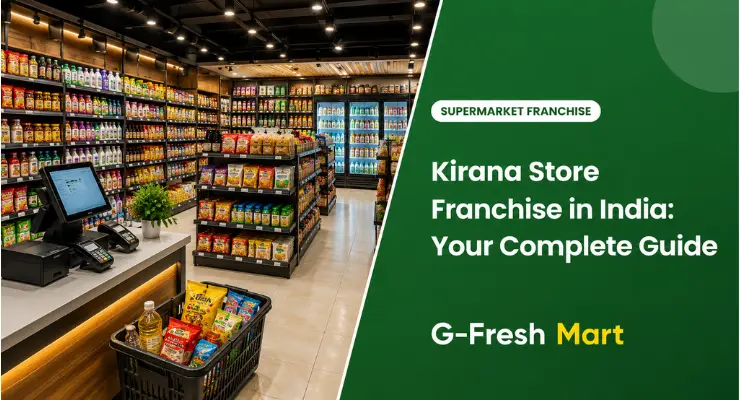

Quick Answer
A kirana store franchise in India lets you open a neighbourhood grocery store under an established brand’s name, using their supply chain, billing software, and operational support from Day 1. India’s kirana sector – approximately 13 million stores nationally – is evolving: customers now expect clean layouts, digital payments, consistent availability, and faster service. A franchise model, like G-Fresh Mart’s Mini Mart format, gives traditional store owners these capabilities without building them from scratch. Investment starts at ₹14 lakh with a 45-day setup and zero royalty for the first 6 months. This guide covers everything: why kirana franchises are growing, how to choose a location, which products drive the most margin, how to run daily operations, and how digital tools are transforming the model.
Introduction
India’s organised retail sector is growing fast – but the kirana store is not going anywhere.
With approximately 13 million neighbourhood stores serving daily grocery needs across every city, town, and village in India, the kirana format remains the backbone of how most Indian households buy their daily essentials. What is changing is how those stores operate.
Customers who were once satisfied with a simple shelf-and-counter arrangement now expect: digital payment options, consistent product availability, clean and organised layouts, faster billing, and a wider range of branded products.
The independent kirana store owner who meets these expectations builds a durable, loyal customer base.
The one who doesn’t, loses customers to organised supermarkets and quick-commerce apps – not because the kirana model is flawed, but because the execution hasn’t kept pace with what customers now want.
A kirana store franchise addresses this gap directly. It gives an individual store owner the brand recognition, supply chain access, billing technology, and operational framework that would take years to build independently.
This guide covers the complete picture: why kirana franchises are growing, how to open one, which products should anchor your shelves, how to run daily operations efficiently, how digital tools are transforming the model, and how G-Fresh Mart’s franchise structure makes all of this accessible without prior retail experience.
Also Read: Grocery Store Franchise: Your Complete Guide for India
1. Why Kirana Store Franchises Are Growing in India
India’s 13 million kirana stores face a genuine competitive challenge in 2026. Quick-commerce platforms offering 10-minute delivery, large-format organised supermarkets expanding into Tier 2 and Tier 3 cities, and the steady growth of online grocery are all competing for the same daily household spending that kiranas have traditionally captured.
The response most successful kirana owners are choosing is not to compete on speed or scale – that is a race they cannot win alone.
Instead, they are leaning into what a neighbourhood kirana genuinely does better than any app or chain: proximity, personal relationships, credit flexibility, and the convenience of a store where regular customers are recognised and their preferences are known.
A franchise model amplifies these natural advantages. Brand recognition earns immediate customer trust in a new location.
A pre-negotiated supply chain gives competitive pricing that independent owners cannot match without decades of supplier relationships.
A cloud-based billing and inventory system makes operations faster, more accurate, and more professional from the first day of trading.
Together, these components give a franchise-model kirana store the feel of a trusted local store with the operational backbone of an organised chain.
Key Drivers Behind Franchise Kirana Growth
- Consumer preference shift: Customers increasingly prefer branded, clean, well-stocked stores over informal unorganised outlets – even for daily household staples. A franchise store meets this preference while maintaining the neighbourhood proximity that quick-commerce cannot.
- Technology accessibility: Affordable POS systems, UPI payment terminals, and WhatsApp-based ordering have removed the technology barriers that once made digitisation difficult for small store owners. These tools are now table stakes for any competitive kirana.
- Organised retail gap in Tier 2/3 cities: Outside metros, organised retail still accounts for less than 10% of total grocery retail. This structural gap makes Tier 2 and Tier 3 cities significantly better entry markets for new franchise kirana stores than saturated metro areas.
- Franchise support reducing first-year risk: The first year of any new store – independent or franchise – is the hardest. A franchise model reduces first-year risk by providing a tested system, a trained supply chain, and operational guidance that shortens the learning curve considerably.
2. Franchise vs. Independent Kirana Store: What’s the Difference?
| Factor | Independent Kirana | Franchise Kirana (G-Fresh Mart) |
| Brand recognition | Built over years from scratch | Immediate – customers already know the brand |
| Supplier pricing | Individual negotiation, market rates | Centralised bulk pricing via network of 1,500+ brands |
| Billing system | Owner-selected, varied quality | Cloud POS pre-configured, lifetime training included |
| Setup timeline | 3-6 months typically | 45 days from site approval |
| Inventory management | Manual or basic software | Integrated inventory alerts, FIFO training, expiry tracking |
| Training | Self-taught or external hire | Structured onboarding + staff training provided |
| Marketing support | Entirely owner-driven | Brand-level marketing + local guidance |
| Royalty | None (but no brand support) | Zero for first 6 months; structured rate from Month 7 |
| Break-even timeline | 18-36 months typically | 12-18 months for Mini Mart in good location |
The key trade-off is straightforward: a franchise owner gives up some operational independence in exchange for a system that has already been tested across hundreds of stores.
For most first-time owners, that trade-off is strongly in favour of the franchise model.
3. How to Open a Kirana Store Franchise in India: Step by Step
Opening a kirana store franchise in India follows a structured sequence. Each step below corresponds to a real decision with real consequences for your investment – skipping or shortcutting any of them is where most preventable mistakes originate.
Step 1: Write a Business Plan Before Anything Else
A business plan is not a formality – it is the document that forces you to answer hard questions before you have committed capital.
Your plan should include: your target catchment area and why you chose it, the investment breakdown and where each rupee comes from, a monthly cash flow projection for the first 12 months including a worst-case scenario, a break-even calculation based on realistic local revenue expectations, and a local marketing plan for the first 90 days.
Every assumption in this plan will be tested by reality; writing it down makes those assumptions visible and correctable before rather than after you have signed a lease.
Step 2: Research Your Target Locality and Customer
Every locality has different customers with different priorities. A residential colony of young working professionals has different grocery needs than a mixed residential market area near a school or hospital.
Understanding your specific target customer – their income level, family size, shopping frequency, and brand preferences – is what determines your initial product mix, pricing strategy, and marketing approach.
Spend one to two weeks visiting the area at different times of day before settling on a final location.
Step 3: Choose and Validate Your Location
Location is the factor that most directly determines your store’s long-term performance. For a kirana franchise, use this checklist before committing to any site:
- 2,000+ households within 1.5 km radius
- No organised supermarket competitor within 1 km
- Ground floor with road visibility from 50+ metres
- Accessible by foot, two-wheeler, and auto
- Commercially zoned (verify legally before signing the lease)
- Rent below 8-10% of realistic projected monthly revenue
- Consistent footfall at 8 AM, 12 PM, and 6 PM on both weekdays and weekends
G-Fresh Mart conducts a formal site survey before approving any franchise location, assessing all seven of the factors above at no additional cost. This survey protects your investment from a poor location decision – one of the most common and most expensive mistakes a first-time franchise owner makes.
Step 4: Obtain Required Permits and Licenses
Every kirana store, franchise or independent, requires specific legal compliance before trading.
The mandatory licenses for an Indian kirana store include: GST Registration, FSSAI Food Safety License (for selling any food products), Trade License from your Municipal Corporation, Shops and Establishments Act registration, and Business Registration (proprietorship, partnership, LLP, or Pvt Ltd).
Most applications take 3-4 weeks to process when submitted simultaneously.
G-Fresh Mart’s franchise onboarding process includes guidance on all of these.
Step 5: Set Up the Store, Technology, and Staff
Store setup covers: interior fit-out per franchise brand standards, billing software installation and configuration, initial inventory procurement and shelving, staff hiring and training, and marketing preparation for opening day.
With G-Fresh Mart’s structured 45-day setup process, all of these run in a coordinated sequence managed by the franchise team rather than independently by the owner.
Step 6: Launch With a Local Marketing Plan
Your opening day sets the tone for your store’s first-impression relationship with the neighbourhood. Effective low-cost opening tactics: flyer distribution in a 500-metre radius 3 days before opening, banners at 3-5 high-visibility local points, a WhatsApp broadcast to your initial contact list with opening-day offers, and a Google Business Profile claimed and active before opening day. G-Fresh Mart also promotes new store openings across its social media channels.
4. Kirana Store Franchise Investment Breakdown
Understanding the full cost structure before investing is the most important financial discipline you can apply. The franchise fee is only one of seven cost components.
| Cost Component | Mini Mart (500 sq ft) | Notes |
| Franchise Fee | ₹2,10,000 + GST | One-time, paid at agreement signing |
| Billing Software | ₹50,000 + GST | One-time; lifetime free training included |
| Security Deposit | ₹1,00,000 | Refundable per franchise agreement terms |
| Interior Cost | ₹6,00,000 | At ₹1,200/sq ft Basic Plan |
| Purchasing Cost | ₹5,00,000 | ~₹1,000/sq ft, location-specific mix |
| TOTAL | ₹14L – ₹19L | Add 10% contingency buffer before committing |
Working capital is the line item most frequently underestimated by first-time investors. Revenue in a new store takes 3-6 months to stabilise, and during that period you still need to pay staff, rent, utilities, and restock shelves every week.
Opening without adequate working capital is the most common cause of cash flow problems in an otherwise well-performing new franchise store. Use the free investment calculator for a city-specific estimate.
5. Which Products Drive the Most Profit in a Kirana Store Franchise?
Most kirana stores run on thin margins in commodity staples like atta, rice, and cooking oil.
These products drive footfall but don’t build the margin that makes a store sustainably profitable. The categories below are where the real margin lives.
| Category | Typical Gross Margin | Why It Matters | Best Products |
| Cheese and dairy | 25-28% | High demand, short shelf life drives fresh turnover | Amul, Britannia – local and processed varieties |
| Personal care and cosmetics | 22-28% | Long shelf life, no spoilage risk, high-value per unit | Soaps, shampoo, toothpaste, skincare |
| Dry fruits and nuts | 20-28% | Health trend driving demand; premium customers | Almonds, cashews, raisins, walnut |
| Snacks and namkeen | 18-28% | High impulse purchase rate; strong brand pull | Lay’s, Kurkure, Haldiram’s, Parle products |
| Tea and coffee | 18-25% | Daily repurchase; strong brand loyalty | Tata Tea, Bru, Nescafé |
| Bottled water | 15-25% | Long shelf life, consistent demand, festival season spike | Bisleri, Kinley, Aquafina |
| Spices | 15-20% | Staple category, low spoilage risk | Everest, MDH, loose quality spices |
| Staple groceries (atta, rice, dal) | 8-15% | Drives footfall; anchor product category | Aashirvaad, India Gate, local brands |
Product Placement Rules That Increase Basket Size
Where you place products in your store directly affects how much an average customer spends per visit. These rules apply regardless of store size:
- Place staples at the back of the store: Rice, atta, and cooking oil belong at the back so customers pass every other aisle on their way. This increases exposure to impulse categories without requiring any price reduction.
- Eye-level shelves for high-margin products: Between 1.2 and 1.5 metres from the floor is where 70% of unplanned purchase decisions are made. Reserve this zone for snacks, personal care, and current promotional items – not commodity staples.
- Billing counter zone for impulse buys: The 1.5 metres before the billing counter is your highest-ROI shelf space. Stock it with small-pack snacks, chocolates, batteries, and sachets – items priced below ₹50 that customers pick up without planning. This zone alone can add ₹30-₹80 to the average transaction value at zero additional marketing cost.
- Seasonal and festive products at the entrance: Change the entrance display every 4–6 weeks to match festivals and seasons. Diwali gift packs, Holi colour kits, Eid dry fruit boxes – placing these at eye level near the entrance triggers purchase consideration before the customer even reaches the main aisles.
6. Daily Operations That Make a Kirana Franchise Profitable
A franchise model provides the system. How you execute within that system every day determines whether the store is profitable or just operational.
The habits below separate consistently profitable kirana franchise stores from ones that struggle despite being in good locations.
Inventory Management Is the Core Discipline
Inventory problems – stockouts, dead stock, and spoilage – are the most common and most costly operational failures in kirana retail. Prevent them with these practices:
- Set reorder alerts on your top 50 SKUs: The 50 products that account for roughly 75% of your daily revenue should have automatic reorder alerts in your POS system set at a 7-day supply threshold. When stock drops to that level, the alert fires – not when the shelf runs empty.
- Apply FIFO without exception: First In, First Out means new stock goes behind existing stock on every shelf fill. New cashier or floor staff ignoring FIFO causes near-expiry stock to pile up behind fresh deliveries, creating write-offs that erode margin weekly.
- Review slow-moving products every 30 days: Any SKU with zero sales in 30 days is costing you shelf space and working capital simultaneously. Either run a 10% discount to clear it, stop reordering, or move it to a more visible location before writing it off.
- Conduct a weekly near-expiry audit: Products within 30 days of expiry move to a dedicated clearance section at a 15-20% discount. Products within 7 days of expiry are removed from shelves immediately. This one habit eliminates most spoilage write-offs.
Staff Management That Runs the Store in Your Absence
A kirana franchise store needs to operate reliably when the owner is not present. That only happens when staff roles are clearly defined, training is thorough, and performance is tracked.
Hire for attitude first and train for skill. Billing software, inventory procedures, and customer service standards can all be taught.
A team member who is naturally polite, helpful, and reliable is worth far more than a technically skilled but difficult employee.
G-Fresh Mart provides staff hiring support and a training programme as part of the franchise package – use both fully rather than hiring informally and hoping the team figures it out.
Assign specific ownership to each function: one person primarily responsible for billing, one for floor and stock, one for daily reconciliation.
Cross-train all staff on at least one additional role so operations are not disrupted when someone is absent.
A store that stops working when a single staff member is sick has an operational fragility problem, not a staffing problem.
Cash Flow and Daily Financial Discipline
Every day of operation should end with a reconciliation of all revenue channels: cash, UPI, and card transactions.
The total from the POS should match the actual cash in the drawer plus the digital transaction log. Discrepancies that take three days to notice take three days to investigate and often cannot be resolved at all.
Catching them the same evening, while the day’s transactions are still clear in everyone’s memory, makes them correctable.
Limit customer credit to a small, defined list of genuinely trusted regular customers with a specific and enforced credit limit.
Unlimited credit to any customer who asks is one of the oldest and most consistent ways kirana stores create cash flow problems – particularly in the first six months when the store needs every rupee of working capital available.
Customer Retention: The Most Cost-Effective Marketing
Acquiring a new customer costs far more than retaining an existing one. In a neighbourhood kirana franchise, customer retention happens through personal recognition and consistent service – not through promotional spend.
Know your regular customers by name. Remember that a specific family prefers a specific brand of atta or a particular type of oil. Handle complaints immediately and personally, not through a staff member passing the message.
Build a WhatsApp Business broadcast list of your regular customers, starting on opening day.
Two messages per week – a weekly offers update on Monday and a festival or seasonal reminder when relevant – keeps your store top of mind for customers who might otherwise default to ordering from an app out of convenience.
This takes 15 minutes per week and consistently outperforms any paid local advertising for a neighbourhood kirana franchise.
7. How Digital Tools Are Transforming the Kirana Store Franchise
The digital transformation of India’s kirana stores is not a future trend – it is happening now, and it is one of the most significant competitive advantages available to franchise-model stores over their independent counterparts.
Digital Payments and UPI
Digital payment acceptance is now a baseline expectation at any Indian retail store. A kirana store that accepts only cash loses a meaningful percentage of potential transactions from customers who now carry little or no cash by habit.
G-Fresh Mart’s pre-configured POS system handles UPI, card, and cash transactions with seamless reconciliation.
A UPI QR code placed visibly at the counter reduces billing queue time and eliminates the persistent problem of change shortages at busy hours.
Cloud-Based POS and Inventory Systems
A cloud-based POS system does more than process transactions – it generates the data that makes every operational decision better.
Daily revenue by category, weekly inventory movement, slow-stock identification, expiry alerts, staff performance by transactions processed, and margin tracking by product line are all outputs of a well-implemented POS system that most independent kirana owners simply do not have access to.
G-Fresh Mart’s billing software, included in the franchise package at a one-time cost of ₹50,000 + GST, covers all of these with lifetime free training for all staff.
Online Presence and Google Business Profile
A claimed and active Google Business Profile is the single highest-impact digital action any kirana franchise owner can take.
When a potential customer in your catchment area searches ‘grocery store near me’ or ‘kirana store near me’, your store appears in the results only if your profile is claimed, has accurate information, and has customer reviews.
Claiming the profile takes 30 minutes. Adding photos of the store interior and exterior, updating hours, and responding to every review within 48 hours takes roughly 2 hours per week.
Stores with active Google Business Profiles consistently generate 3-5 new customer visits per week from local search discovery alone.
WhatsApp Business for Local Marketing
WhatsApp Business is the most cost-effective local marketing tool available to a kirana franchise store.
A broadcast list of 300–500 regular customers, messaged twice weekly with current offers and new arrivals, generates measurable repeat footfall at zero cost.
It also functions as an informal order channel – regular customers who message to ask ‘do you have Brand X?’ before making a trip create a micro-ordering system that builds loyalty and reduces their effort without requiring any formal app or delivery infrastructure.
8. Common Mistakes Kirana Franchise Owners Make
| Mistake | Why It Happens | How to Avoid It |
| Overstocking on low-margin staples | Initial excitement leads to over-ordering | Match order quantity to realistic weekly sell-through, not wishful thinking |
| Ignoring expiry dates | No formal checking process | Weekly near-expiry audit + FIFO as a non-negotiable staff procedure |
| Unlimited customer credit | Reluctance to say no to regulars | Set a named list, a rupee limit, and enforce it consistently from Day 1 |
| Not using the POS system fully | Billing only; ignoring reports | Spend 15 minutes daily reviewing key metrics – not just daily revenue total |
| No local marketing | Assuming footfall will arrive on its own | WhatsApp list from Day 1; Google Business Profile before opening day |
| Hiring informally, no training | Quick fix for staff pressure | Use franchisor hiring support; every new hire goes through formal billing training before serving customers |
| Under-budgeting working capital | Only budgeting the headline investment | Reserve minimum 3 months of operating costs before opening, separate from initial stock and fit-out budget |
Start Your Kirana Store Franchise Journey
A kirana store franchise combines the most stable product category in Indian retail – daily household essentials – with the brand support, supply chain access, and operational framework that individual store owners cannot build independently in their first year. The customers are there.
The demand is structural. What determines success is the quality of execution: right location, disciplined inventory, well-trained staff, and consistent local marketing.
G-Fresh Mart’s franchise model starts at ₹14 lakh for a Mini Mart format with a 45-day setup and zero royalty for the first 6 months.
The brand’s 400+ operational stores across 22+ states give you a network of existing franchise owners you can speak to directly before committing – which is the most reliable due diligence available. Apply for a free consultation at franchise, or calculate your city-specific investment at a calculator.
Frequently Asked Questions
Is a kirana store franchise profitable in India?
Yes. A well-managed kirana store franchise in a suitable location generates gross margins of 18-25% on the product mix and typically reaches break-even within 12-18 months for a Mini Mart format. Daily household essentials are recession-resistant products with consistent repeat purchase demand – the demand side of a kirana business does not disappear regardless of economic conditions.
How much investment is needed to open a kirana store franchise?
A G-Fresh Mart Mini Mart kirana franchise requires approximately ₹14-25 lakh in total investment for a 500 sq ft store, including franchise fee (₹2,10,000 + GST), billing software (₹50,000 + GST), interior fit-out, initial stock, and 3 months of working capital. Larger Super Mart formats require ₹25-90 lakh. Use the calculator for a city and size-specific estimate.
What are the most profitable products to stock in a kirana store?
The highest-margin categories in a kirana store are personal care and cosmetics (20-25% gross margin), cheese and dairy (25-28%), dry fruits (20-28%), snacks and namkeen (18-28%), and tea and coffee (18-25%). Commodity staples like atta and rice drive footfall but carry lower margins of 8-15%. Stocking a balanced mix of both footfall drivers and high-margin categories is the key to a consistently profitable product mix.
How does a kirana franchise compete with quick-commerce apps?
A kirana franchise competes through proximity, personal service, and product availability that apps cannot replicate. A customer who needs a specific item immediately, wants to see and select fresh produce in person, or prefers to avoid delivery fees will always choose a nearby reliable store over an app. Building that reliability – consistent stock on key products, personal recognition of regular customers, and a WhatsApp broadcast of weekly offers – is the ongoing competitive strategy that makes a neighbourhood kirana franchise defensible.
What support does G-Fresh Mart provide to kirana franchise owners?
G-Fresh Mart provides: 45-day structured store setup from site approval to opening day, access to 20,000+ products from 1,500+ brand partners, cloud POS and inventory software (₹50,000 + GST one-time, lifetime training), staff hiring assistance, 3 months of free accounting support, 3 months of free backend purchase entry support, regular field visits from the operations team, and seasonal marketing campaign support.