
Quick Answer
Supermarket franchise cost in India ranges from ₹14 lakh for a Mini Mart (500-1,000 sq ft) to ₹ 2.5 crore for a Hypermart (4,000-10,000 sq ft). A G-Fresh Mart franchise specifically includes the franchise fee (₹2,10,000 + GST), software fee (₹50,000 + GST), security deposit (₹1,00,000), plus stock and interior fit-out at ₹1,000-₹1,200 per sq ft depending on store size. Setup is completed in 45 days. No royalty for the first 6 months. Apply at G-Fresh Mart Franchise.
A supermarket franchise in India costs between ₹14 lakh and ₹ 2.5 crore – and what you pay is determined by store size, city, brand, and how you structure your investment.
you are looking at G-Fresh Mart specifically, the entry point is ₹14 lakh for a mini mart, scaling to ₹2.5 crore for a Hypermart.
Every rupee of that investment is accounted for in a fixed breakdown: franchise fee, software, security deposit, interior fit-out, opening stock, and working capital buffer.
This guide covers every cost component in detail, shows what your investment actually buys you through G-Fresh Mart’s franchise package, and gives you realistic revenue and break-even figures based on actual store performance data across 400+ G-Fresh Mart outlets in 22 Indian states.
If you are reading this to make a real investment decision, you will have exact numbers by the time you finish.
1. Why Supermarket Franchise Is a Structurally Sound Investment in India Right Now
Before looking at costs, understanding the market opportunity tells you whether the investment is worth making at all. The numbers are unambiguous.
India’s retail market crossed ₹88 lakh crore in 2026 and is growing at 11.40% CAGR through 2035. The grocery segment specifically is expanding at 9% CAGR from 2026 to 2030.
The number that matters most for a franchise investor is this: organised retail – branded supermarkets and franchise grocery stores – currently holds a relatively small share of India’s grocery market.
That share is projected to reach 35% by 2030 at 8–9% CAGR.
What this means in plain terms: most grocery purchases in India are still made at local kirana stores, open bazaars, and unorganised wholesale markets.
The transition to organised retail is happening now and accelerating, particularly in Tier 2 and Tier 3 cities.
Several converging forces are driving this shift:
- Rising disposable incomes in smaller cities, where the emerging middle class wants quality, variety, and reliable supply – not just the cheapest price.
- A growing base of younger consumers who make purchasing decisions based on brand trust, hygiene standards, and product range. Shopping experience matters to this group, not just transaction completion.
- Rapid urbanisation creating dense residential catchments where a well-run neighbourhood supermarket becomes a daily destination rather than an occasional trip.
- Post-pandemic consumer behaviour that permanently shifted toward reliable, nearby, properly maintained retailers. This shift has not reversed – it has deepened.
- Widespread adoption of digital payments making in-store transactions faster, easier, and more traceable for both customers and store owners.
The combined effect: a grocery franchise investment made in 2026 enters a market that is structurally expanding. The window for first-mover advantage in Tier 2 and Tier 3 cities is real and finite.
2. The Real Cost of a Supermarket Franchise: Every Component Explained
The most common mistake prospective franchise investors make is asking “what is the total investment?” without understanding what goes into that number.
A total figure means nothing without the breakdown. Here is every cost component you will actually face, with honest ranges.
The Franchise Fee: Buying Proven Brand Equity
The franchise fee is a one-time payment to the franchisor that gives you access to the brand name, business model, established supply chain, and ongoing operational support.
Think of it not as a cost but as the purchase of brand equity that you would otherwise spend years building from scratch.
Supermarket franchise fees in India vary significantly by brand size:
| Brand Tier | Typical Franchise Fee | Example Brands |
| Smaller regional brands | ₹10-15 lakh | Regional grocery chains |
| Mid-range national brands | ₹20-30 lakh | Spencer’s, Easyday |
| Premium large-format brands | ₹40-50 lakh | Big Bazaar, Reliance Fresh |
| G-Fresh Mart | ₹2,10,000 + GST | 400+ stores, 22 states |
G-Fresh Mart’s franchise fee of ₹2,10,000 + GST is significantly lower than comparable national brands.
This is not a compromise on brand quality – it is the brand’s positioning decision to make franchise ownership accessible to first-time entrepreneurs, particularly in Tier 2 and Tier 3 markets.
The 400+ store network across 22 states provides the brand recognition that converts the low fee into genuine market advantage.
Real Estate and Rent: Your Most Strategic Decision
Location is not a cost line in your budget – it is your single most important revenue decision.
The gap between a good location and a mediocre one can represent ₹3-5 lakh per month in revenue difference.
Monthly rental cost by market type:
- Tier 2 cities (Jaipur, Lucknow, Patna, Coimbatore): ₹15,000-₹40,000 per month for a 1,000–2,000 sq ft commercial space.
- Metro cities (Delhi, Mumbai, Bangalore, Hyderabad): ₹40,000-₹1,00,000 per month for similar space.
- Tier 3 cities and smaller towns: ₹8,000–₹20,000 per month – lower costs with growing organised retail demand.
The mistake first-time investors make consistently is choosing a location to minimise rent. This trade-off almost always costs more than it saves.
A location with ₹15,000 lower monthly rent but half the footfall will generate ₹2-3 lakh less in monthly revenue. The arithmetic never works in favour of cheap rent.
G-Fresh Mart conducts a formal site survey for every franchise application.
The survey evaluates residential density (minimum 200 households within 500 metres), road visibility, proximity to schools and regular market clusters, competition within 500 metres, and lease term viability.
This support protects your investment from the beginning.
Store Setup and Infrastructure
Getting your store operational – shelving, racks, billing counters, flooring, lighting, signage, refrigeration – constitutes a significant portion of your capital investment.
These are one-time costs that set the physical foundation of your business.
Key infrastructure cost ranges:
- Refrigeration units for dairy, frozen foods, and fresh produce: ₹35,000-₹2 lakh depending on capacity and number of units.
- Billing and POS infrastructure including hardware and software: ₹50,000-₹2 lakh.
- Shelving, racks, and interior fit-out: ₹1,000-₹1,200 per sq ft. A 1,500 sq ft store requires ₹15-18 lakh in interior costs alone.
- Signage and external branding: ₹50,000-₹1.5 lakh depending on store frontage.
G-Fresh Mart includes the full infrastructure package – branded shelving, refrigeration, billing counters, technology infrastructure, interior layout, and store branding – as part of the franchise setup.
You are not sourcing each component individually from different vendors, which typically adds 20-30% to these costs through coordination complexity and procurement inefficiency.
Initial Inventory: First Impressions Are Non-Negotiable
The value of a grocery store on Day 1 is directly proportional to how full and well-organised its shelves look.
Customers who walk into a sparsely stocked new store do not give it a second chance – they return to the kirana they already trust. Your opening day inventory is a revenue-generating asset, not just a purchase.
Initial inventory investment by store size:
- Mini Mart (500-700 sq ft): ₹3-5 lakh for a full, well-presented launch inventory.
- Mid-format store (1,500-3,000 sq ft): ₹8-15 lakh covering daily staples, branded FMCG, personal care, and household goods.
- Large format with fresh and frozen: ₹20-40 lakh to properly stock all categories including cold chain products.
G-Fresh Mart’s franchise package includes opening day inventory stocking. Your shelves are full before the first customer walks in.
This detail, which many franchise brands handle poorly, is a significant competitive advantage in your first critical month.
Working Capital: The Most Underestimated Investment
Working capital is the cash your business needs to operate between buying inventory and collecting revenue.
It covers rent payments, staff salaries, utility bills, and restocking costs while customer revenue is building. Even a fundamentally profitable store can fail in its first six months if working capital is inadequate.
The practical rule: maintain a minimum 2-3 months of operating expenses as a ready cash buffer above your setup investment.
For a mid-format G-Fresh Mart store, this means ₹3-8 lakh in immediately accessible cash.
First-time franchise investors consistently underestimate this figure.
They budget correctly for setup and inventory, then find themselves cash-constrained in months 2–4 when the business is profitable on paper but cash flow is still building.
G-Fresh Mart’s zero-royalty structure for the first 6 months directly addresses this: every rupee of early revenue stays in the business rather than flowing out as franchisor payments.
Read More: Mini Supermarket Franchise – Full Setup Guide
3. G-Fresh Mart Complete Investment Breakdown by Store Format
Here is the exact investment structure for a G-Fresh Mart franchise, followed by the total investment range by store format.
| Investment Component | Cost |
| Franchise fee | ₹2,10,000 + GST |
| Software fee (per login) | ₹50,000 |
| Security deposit | ₹1,00,000 |
| Stock (at ₹1,000 per sq ft) | Scales with store size |
| Interior and setup (₹1,000-₹1,200 per sq ft) | Scales with store size |
| Working capital buffer (recommended) | ₹3–8 lakh depending on format |
| Store Format | Size | Total Investment | Monthly Revenue | Profit Margin | Break-Even |
| Mini Mart | 500-1,000 sq ft | ₹14-25 lakh | ₹5-25 lakh | 20-25% | 12-18 months |
| Super Mart | 1,500-4,000 sq ft | ₹25-90 lakh | ₹25-90 lakh | 22-25% | 15-22 months |
| Hyper Mart | 4,000-10,000 sq ft | ₹90 L-2.5 cr | ₹50-1.5 crore | 25-28% | 18-24 months |
Use the G-Fresh Mart franchise investment calculator to get an exact figure for your chosen store size, city, and plan type.
4. What ₹14 Lakh Actually Buys You at G-Fresh Mart
G-Fresh Mart was founded in 2017 and introduced its franchise model in 2021.
Since then it has grown to 400+ stores across 250+ cities and 22+ Indian states – one of the fastest expansions in the organised supermarket franchise category.
The brand was recognised as Best Start-Up of the Year in FMCG at the Right Choice Award 2023.
When investors see an entry investment of ₹14 lakh, the immediate question is: what exactly does that include? The answer is comprehensive.
Physical Infrastructure
Branded shelving, racks, billing counters, and all required store equipment are included in the franchise setup package. You are not managing individual vendor contracts for each component.
The entire store infrastructure is delivered and installed as a single coordinated package – eliminating coordination overhead and cost overruns common in independent sourcing.
Opening Day Inventory
Your shelves are fully stocked before Day 1. This matters more than most new franchise owners realise.
Empty shelves on opening day permanently damage first impressions – customers who visit an empty store return to their existing kirana and rarely come back.
G-Fresh Mart ensures your opening day looks like an established store, not a work in progress.
Technology and Billing Software
Advanced billing software and hardware are provided. Included: 3 months of accounting software subscription and 3 months of backend purchase support.
The billing software handles inventory tracking, sales reporting, and customer billing in a single integrated system. You are not building your technology stack from scratch.
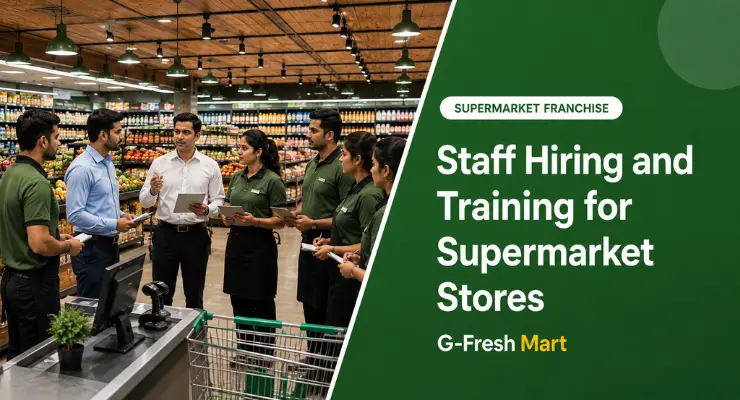
Staff Hiring and Training
G-Fresh Mart manages hiring and training for your store team. This covers billing software operation, inventory management standards, customer service expectations, and store presentation protocols.
For a first-time entrepreneur without retail experience – which describes the majority of G-Fresh Mart’s franchisees – this support eliminates the most operationally complex aspect of launching a retail store.
A standard mini to mid-format G-Fresh Mart store requires 3-6 people at launch: one store manager or supervisor, 2-3 floor staff, and one billing counter operator.
G-Fresh Mart’s hiring and training team handles this entire process.
45-Day Store Opening Guarantee
From site handover to a fully operational store – shelved, staffed, branded, and open – in 45 days. This is faster than most franchise categories and significantly faster than independent store setup.
The financial implication is direct: every week of delay between investment and opening is a week of rent paid with zero revenue. G-Fresh Mart’s 45-day commitment accelerates your path to first revenue.
Digital Marketing Activation – Fully Included
Promotion on Facebook, Instagram, and YouTube begins before opening day. A free website is activated for 2 years.
Offline promotion – hoardings, neighbourhood banners, promotional flyers for residential societies – creates community awareness in your catchment area before the store opens.
Most franchise models treat marketing as an additional cost borne by the franchisee. G-Fresh Mart includes the full marketing activation.
For a new franchise owner managing operations, logistics, and staff simultaneously, having professional marketing infrastructure running from Day 1 removes an entire category of operational complexity.
Royalty Structure
Zero royalty for the first 6 months. After month 6, a royalty of 3% of monthly sales applies – but only on sales above ₹20 lakh per month. Stores generating monthly sales below ₹20 lakh pay no ongoing royalty at all.
To put this in context: a well-located mini mart doing ₹12-15 lakh per month in its first year pays ₹0 in royalty, permanently, unless and until sales exceed ₹20 lakh.
This is one of the most franchisee-friendly royalty structures in the Indian organised retail sector.
Lifetime Operational Support
G-Fresh Mart’s support does not end at launch. Backend support, software training and updates, supply chain access, and ongoing operational guidance continue for the duration of the franchise.
As your store grows, adds new product categories, and encounters new operational challenges, the support infrastructure remains available. You own the business – you are not navigating it alone.
Also Read: How to Start a Supermarket Franchise in India
5. The Five Factors That Determine Your Investment and Returns
Understanding what drives profitability is more valuable than understanding cost components.
These five factors affect your investment requirements and earning potential more than anything else.
Factor 1: Brand Reputation and Market Presence
The brand you choose determines both your franchise fee and your day-one revenue potential.
A well-recognised brand means a significant portion of your marketing is done before you open.
Customer trust, built through brand familiarity, converts passing foot traffic into first-time visitors – and first-time visitors into loyal weekly shoppers.
G-Fresh Mart’s presence across 400+ stores and 22+ Indian states creates the brand recognition that makes customers curious about a new store rather than indifferent to it.
In cities where G-Fresh Mart is already established, franchise owners report faster ramp-up in customer volume and shorter time to break-even than comparable independent stores.
Factor 2: Location and Geographic Territory
Your store’s location determines more of your profitability than any other single variable.
A store positioned close to a residential colony, school, daily market cluster, or high-footfall intersection generates consistent, predictable revenue.
One positioned on a secondary road with limited visibility fights for every customer.
Treat location as your most important asset investment, not your most flexible cost.
G-Fresh Mart’s site assessment process uses performance data from 400+ existing stores to evaluate your proposed location – a competitive intelligence advantage that independent retailers cannot replicate.
Factor 3: Store Size and Format
Starting costs range from ₹14 lakh for a mini format to ₹83 lakh for a Hypermart.
Your optimal store size is not the largest you can afford – it is the size that matches actual demand in your catchment area, your available capital, and your operational management capacity.
G-Fresh Mart accepts stores from 500 sq ft to 10,000 sq ft, with most franchises operating between 700 sq ft and 3,000 sq ft.
This range means you can start at the scale that makes financial sense for your market, rather than being forced into a single prescribed format.
Factor 4: Equipment, Technology, and Cold Chain Infrastructure
Modern organised retail is not just about filling shelves. Cold chain infrastructure, a reliable POS system with real-time inventory management, and proper security systems are operational necessities – not optional upgrades.
The cost of sourcing, procuring, and integrating these independently typically adds 20-30% to the infrastructure budget compared to receiving them as a coordinated package.
G-Fresh Mart’s franchise package eliminates this inefficiency. Everything is sourced, delivered, and installed by the same team that sets up your store.
Factor 5: Working Capital Discipline
Grocery retail is a low-margin, high-turnover business. Working capital management is not a finance function – it is an operational skill that determines whether your store survives its first year or not.
The most common cause of failure for independent grocery stores in India is not insufficient revenue – it is inadequate working capital in the first 4-6 months while revenue is building.
G-Fresh Mart’s zero-royalty structure for 6 months directly addresses this: every rupee of early revenue stays in the business where it belongs.
6. Profitability, ROI, and What Real G-Fresh Mart Numbers Look Like
Profit Margins
The industry average net profit margin for supermarkets in India is 10–15%. G-Fresh Mart franchisees achieve 20–35% profit margins on average, driven by the brand’s supply chain negotiating power and the diversity of the 20,000+ SKU product catalogue across 1,500+ brands.
A wider product range increases basket size, and better supply chain terms improve margins on each sale.
Monthly Revenue and Profit by Store Size
| Store Size | Monthly Revenue | Profit Margin | Monthly Profit | Break-Even |
| Mini Mart (500–700 sq ft) | ₹5-12 lakh | 20-25% | ₹1-3 lakh | 12-18 months |
| Super Mart (700–1,500 sq ft) | ₹12-25 lakh | 22-30% | ₹2.6-7.5 lakh | 12-20 months |
| Mid Format (1,500–3,000 sq ft) | ₹25-50 lakh | 25-35% | ₹6-17 lakh | 15-24 months |
Return on Investment
A G-Fresh Mart franchise at the ₹13-20 lakh investment tier can achieve ROI of 45% or higher. Break-even typically occurs in the 12-24 month window – significantly faster than restaurants (24-36 months) or retail clothing franchises (24-30 months).
Grocery is a daily-demand category: unlike discretionary retail, your customers need to return every week regardless of economic conditions.
The Franchisee Success Rate
G-Fresh Mart’s franchisee success rate across 400+ stores is very high. In a country where independent retail stores have a documented high failure rate in their first two years, this figure is not a marketing claim – it is a track record built across hundreds of real-world store launches.
This rate results from three structural advantages: disciplined site selection, a proper onboarding and training process, and continued operational support that does not disappear after launch.
Franchisees who follow the system consistently outperform independent store owners at every comparable scale.
7. The FOFO Model: Ownership With a Support System
G-Fresh Mart operates exclusively on the FOFO model – Franchise Owned, Franchise Operated. As a franchisee, you own the outlet.
You are responsible for day-to-day operations: staff management, inventory ordering, rent, utilities, and customer experience.
G-Fresh Mart provides the brand, business model, product supply chain, technology infrastructure, marketing support, and training.
The significance of this model becomes clear when you consider the alternative.
Opening an independent supermarket means building every component from zero: supplier relationships, procurement processes, brand recognition, technology systems, and operational procedures.
Every problem is solved without the benefit of 400 other stores that have encountered and resolved the same issue.
The FOFO model means you bring capital, local market knowledge, and daily commitment. G-Fresh Mart brings the systems, supply chain leverage, and brand authority.
Neither party achieves the same result independently. The combination is the value proposition.
8. From Application to Grand Opening: The 45-Day Process
The G-Fresh Mart franchise process is more structured than most first-time investors expect. Here is exactly what happens between your initial enquiry and your store opening day.
Weeks 1-2: Research and Initial Enquiry
Start with an honest assessment before any money changes hands. What is your total available investment – and does it include 2–3 months of working capital beyond setup costs? Do you have a location in mind, or do you need help identifying one? Are you planning to manage the store directly or through a store manager you trust?
Once these basics are clear, contact G-Fresh Mart through the franchise application page at G-Fresh Mart Franchise,
The franchise team provides detailed information specific to your market and investment level, and gives you an honest performance assessment for your target location based on comparable existing stores.
Weeks 2-3: Business Plan and Investment Preparation
Total investment depending on format and city is ₹13–30 lakh.
Your business plan should include investment allocation, monthly revenue projections benchmarked against similar G-Fresh Mart stores in comparable markets, your projected break-even date, and your operational management plan.
G-Fresh Mart’s team helps you model realistic figures rather than aspirational ones.
Weeks 3-4: Site Selection
G-Fresh Mart conducts the site survey and evaluates your proposed location against these criteria: residential density of 200+ households within a 500-metre radius; clear road visibility and pedestrian accessibility; proximity to schools, regular markets, and commuter routes; competition analysis within 500 metres; lease terms of 3–5 years with renewal provisions.
Minimum store area is 500 sq ft. Most G-Fresh Mart stores operate between 700 sq ft and 3,000 sq ft.
Weeks 3-5: Licensing and Compliance
Key registrations required: FSSAI Food Business Licence (mandatory for all food retail), GST Registration, Shops and Establishment Act Registration, Trade Licence from your local municipal corporation.
Start the licensing process immediately after location confirmation – paperwork delays are the most common cause of missed opening timelines, and they are entirely avoidable.
Weeks 3-6: Store Setup and Fit-Out
G-Fresh Mart’s turnkey setup begins: branded shelving delivered and installed, refrigeration units commissioned, billing counters and POS hardware configured, technology infrastructure connected, store interior completed to brand standards.
Opening day inventory is stocked in the final days before opening. Your shelves are full on Day 1.
Weeks 5-6: Staff Hiring and Training
G-Fresh Mart hires and trains your complete launch team: store manager, 2-3 floor staff, billing counter operator.
Training covers billing software operation, inventory management processes, customer service standards, and store presentation protocols. Staff are ready to operate independently by opening day.
Week 6: Marketing Activation and Community Awareness
Digital marketing begins before the store opens: Facebook, Instagram, and YouTube promotion reaches your local catchment area.
Offline promotion – hoardings, neighbourhood banners, flyers distributed to residential societies – creates community awareness in the weeks before launch.
Your free 2-year website goes live. By opening day, your target customers know you are coming.
Day 45: Grand Opening
A fully stocked store, a trained and ready team, active digital and offline marketing, and a local community that already knows your name. This is what G-Fresh Mart delivers at the 45-day mark.
9. The First 90 Days: Building a Business That Lasts
Your grand opening is the beginning, not the result. The habits established in the first 90 days – inventory discipline, staff performance, customer relationships, and community presence – will either compound into a successful neighbourhood supermarket or expose gaps that become progressively harder to fix.
Be Present in the Store
A franchise owner who is physically present in the store during the first few weeks establishes trust with customers and demonstrates seriousness to staff.
Customers who see the owner actively managing the store become advocates. Staff who see the owner engaged perform differently than those who do not.
Presence in the first 90 days is an investment with compounding returns.
Track Your Data From Day One
G-Fresh Mart’s billing and inventory software generates actionable data from the first transaction. Use it.
Your top-selling SKUs, slow-moving inventory, daily revenue patterns, and category margins will tell you more about your specific market in 90 days than any external analysis could.
Make restocking decisions based on your data, not assumptions.
Build Your Local Community Presence
Create a neighbourhood WhatsApp group for regular customers and share weekly offers, new arrivals, and festive specials directly.
A group of 200 engaged local customers is a business asset that costs nothing to maintain. Franchisees who build this community connection in their first 90 days consistently outperform those who rely solely on brand-level marketing.
Never Let Key Shelves Go Bare
When a customer cannot find a staple product – cooking oil, atta, dal, rice – they go back to the kirana they used before your store existed.
And they often stay there. Establish buffer stock for your 20–30 fastest-moving SKUs. Treat empty shelves on core categories as a non-negotiable operational failure.
10. What Actual G-Fresh Mart Franchise Owners Say
The most credible perspective on any franchise model comes from people who have made the investment and operated the business. These are direct accounts from G-Fresh Mart franchisees.
“I was looking for a business I could run alongside my existing income. The 45-day setup guarantee meant my store was operational faster than I expected. Within the first three months, we had built a loyal customer base in our residential colony. The digital marketing support alone has been worth it – customers come in saying they saw us on Instagram.” – Rajesh Sharma, Jaipur, Rajasthan
“What made me choose G-Fresh Mart over other grocery franchise options was the transparent royalty structure. Knowing I pay zero royalty for the first six months let me invest those savings back into growing my inventory and customer experience. The brand recognition did the rest.” – Priya Menon, Coimbatore, Tamil Nadu
“I had no prior retail experience. The staff training provided by G-Fresh Mart ensured my team was ready from Day 1. The billing software is straightforward and the backend support is responsive. Within 14 months, I recovered my investment and am now planning a second outlet.” – Amit Verma, Patna, Bihar
Three different cities, three different starting points, one consistent outcome: the system works for people who follow it, including those with no prior retail experience.
11. Common Mistakes to Avoid as a First-Time Franchise Owner
Underestimating Working Capital
The most frequent mistake among first-time franchise investors is correctly budgeting setup and inventory costs, then underestimating working capital by 3–6 months.
Profitability on paper does not pay rent if the cash is not in the account. Maintain a minimum 2–3 months of operating expenses as a ready buffer before you open.
Choosing Location for Low Rent Rather Than Footfall
Lower rent saves costs but consistently reduces daily customer count. Supermarkets perform best near residential colonies, schools, and busy neighbourhood roads.
A ₹15,000 saving in monthly rent that costs you 30 customers per day is a net loss of ₹60,000–₹90,000 in monthly revenue. The mathematics never favour cheap location.
Neglecting Inventory Management
Dead stock – products sitting on shelves unsold – silently erodes your margins without being immediately visible in your P&L. Monitor stock movement weekly, not monthly.
Know which SKUs in your specific location move fast and which do not, and adjust orders accordingly. G-Fresh Mart’s billing software provides this data automatically — use it.
Ignoring Your Local Digital Presence
G-Fresh Mart provides brand-level marketing support. But franchisees who actively manage their Google Business Profile, maintain a local WhatsApp ordering group, and post regularly about their specific store on social media consistently outperform those who rely solely on brand-level marketing.
Local presence complements brand marketing – it does not replace either one.
12. Is a Supermarket Franchise the Right Investment for You?
A supermarket franchise makes sense if you are looking for a business that addresses a permanent, non-negotiable daily need – food and household essentials.
It generates revenue from Day 1 without months of brand building. It provides a structured operating model with defined support rather than requiring you to figure everything out independently.
And it offers a realistic break-even in 12-24 months – faster than most franchise categories.
G-Fresh Mart specifically makes sense if you want national brand recognition at an accessible entry investment, full operational support without giving up store ownership, and a business model proven across 400+ real stores in 22 Indian states.
The market is growing. The organised retail transition in India is accelerating, particularly in Tier 2 and Tier 3 cities where G-Fresh Mart has significant presence. The infrastructure is built. The opportunity is real.
Calculate your exact investment or apply for a franchise.
Frequently Asked Questions: Supermarket Franchise Cost in India
How much does a supermarket franchise cost in India?
Supermarket franchise cost in India ranges from ₹14 lakh for a mini mart (500-1,500 sq ft) to ₹83 lakh for a Hypermart (4,000-10,000 sq ft). For G-Fresh Mart, the fixed costs are: franchise fee ₹2,10,000 + GST, software fee ₹50,000, security deposit ₹1,00,000, plus stock and interior at ₹1,000-₹1,200 per sq ft depending on store size.
What is G-Fresh Mart’s royalty structure?
Zero royalty for the first 6 months. After month 6, a royalty of 1% of monthly sales applies only on sales above ₹20 lakh per month. Stores generating monthly revenue below ₹20 lakh pay no ongoing royalty at all. This is one of the most franchisee-friendly royalty structures in Indian organised retail.
What profit margin can I expect from a G-Fresh Mart franchise?
G-Fresh Mart franchisees achieve 20-35% profit margins depending on store size, location, and sales volume. The industry average for Indian supermarkets is 10–15%. A well-located mid-format store generates monthly profits of ₹70,000 to ₹1.5 lakh.
How quickly can I break even on a supermarket franchise investment?
G-Fresh Mart franchise stores typically break even within 12-24 months depending on format and location. This is faster than restaurant franchises (24-36 months) and most retail clothing franchises. Grocery is a daily-demand category – customers return every week regardless of economic conditions.
What does the FOFO model mean for a franchise owner?
FOFO stands for Franchise Owned, Franchise Operated. You own and operate your store – you manage staff, inventory, rent, and daily operations. G-Fresh Mart provides the brand, supply chain, technology, marketing, and training. You have full entrepreneurial ownership with a national support system behind you.
What is the minimum area for a G-Fresh Mart franchise?
Minimum 500 sq ft. Most G-Fresh Mart stores operate between 700 sq ft and 3,000 sq ft. Three formats are available: Mini Mart (500-1,500 sq ft), Super Mart (1,500-4,000 sq ft), and Hyper Mart (4,000-10,000 sq ft)
What is included in the G-Fresh Mart franchise package?
The franchise package includes physical store infrastructure (shelving, billing counters, refrigeration), opening day inventory, billing software and hardware, 3 months accounting software subscription, staff hiring and training, 45-day store setup guarantee, digital marketing activation on Facebook/Instagram/YouTube, free website for 2 years, offline promotional materials, and lifetime operational support.
Is a supermarket franchise a good investment in India in 2026?
Yes, for investors who choose the right brand and location. Organised grocery retail is growing at 8–9% CAGR through 2030. The majority of Indian grocery purchases still happen at unorganised kirana stores – the transition to organised retail is ongoing and accelerating. G-Fresh Mart’s 92% franchisee success rate across 400+ stores, combined with an accessible ₹14 lakh entry investment and zero royalty for 6 months, makes it one of the better-structured opportunities at this price point.