
Quick Answer
A grocery store franchise lets you open a supermarket under an established brand’s name, using their supply chain, billing software, and training instead of building a business from scratch. In India, entry-level investment starts around ₹14 lakh for a 500-1,000 sq ft Mini Mart, with G-Fresh Mart offering a 45-day setup timeline and zero royalty for the first 6 months. Calculate your exact investment in G-Fresh Mart.
Introduction
A grocery store franchise costs less to start, takes less time to open, and carries lower risk than building an independent supermarket from zero.
That is the entire case for franchising in one sentence – and it is also the reason India’s organised grocery retail sector, currently under 15% of the total ₹60 lakh crore market according to IBEF, is attracting record numbers of first-time investors in 2026.
Most guides on this topic repeat the same surface-level advice: pick a good location, choose a trusted brand, do your research. None of that tells you what you actually need to know before signing an agreement and writing a cheque for 14 lakh rupees or more.
This guide focuses on the part most articles skip: what a grocery franchise actually costs broken down to the rupee, how the business model works day to day once the doors are open, what separates a profitable franchise store from a struggling one, and how the economics compare against building an independent store from scratch.
You will find real investment figures with itemised cost components, a structural comparison of franchise versus independent retail, the specific operational variables that determine whether a given store turns a profit, and a realistic timeline for going from first inquiry to opening day.
Every claim in this guide includes a specific number or named source – vague reassurances are not useful when you are making a six-figure to seven-figure financial decision.
If you have already decided on a format and want the exact setup process, see our step-by-step guide to starting a supermarket franchise in India for the full 7-step breakdown.
What Is a Grocery Store Franchise?
A grocery store franchise is a legal arrangement where you (the franchisee) pay a fee to operate a store under an established brand’s name, products, and systems, while the brand (the franchisor) provides supply chain access, training, and ongoing support.
You own the store and the daily profit; the franchisor owns the brand standards you agree to follow.
This differs from a company-owned grocery chain, where you would work as an employee or manager without ownership.
It also differs from opening an independent grocery store, where you would need to build brand trust, negotiate with hundreds of suppliers individually, and design every operational system yourself – typically taking 6 months or longer before opening day.
Within franchising itself, there are two distinct ownership structures, and the difference matters more than most first-time investors realise.
In a FOFO (Franchise Owned, Franchise Operated) model, you own the store, manage it day to day, and keep all profit after the franchise fee and royalty.
In a FOCO (Franchise Owned, Company Operated) model, the franchisor manages daily operations while you provide capital and earn a fixed return or revenue share – closer to a passive investment than a business you run.
G-Fresh Mart operates exclusively on the FOFO model, meaning every franchise owner is the active operator of their own store.
| Model | Who Owns the Store | Who Keeps the Profit | Setup Time |
| Franchise (FOFO) | You | You, after franchise fee and royalty | 45-60 days |
| Company-Owned Chain | The brand | The brand (you may earn a salary) | Not applicable |
| Independent Store | You | You | 3-6 months typically |
One distinction worth understanding before you go further: a grocery store franchise is not the same as a distributorship or a dealership, even though the terms get used loosely in casual conversation.
A distributor sells a brand’s products wholesale to other retailers and does not operate a branded storefront.
A franchise operates the actual customer-facing store under the brand’s name, visual identity, and operating standards – which is why franchise agreements are considerably more detailed than distribution contracts, covering everything from store layout to staff uniforms to product placement.
How Does the Grocery Franchise Business Model Work?
The grocery franchise model has three core components that work together to reduce your risk compared to starting independently.
Understanding how each one functions in practice – not just in theory – is what separates investors who go in with realistic expectations from those who get blindsided six months after opening.
Supply Chain Access
Instead of negotiating individually with FMCG brands, you inherit the franchisor’s existing supplier agreements. G-Fresh Mart, for example, has partnerships with 1,500+ brands including HUL, ITC, Nestle, Amul, and Britannia – giving every franchise store bulk-rate pricing that an independent shop could never secure on its own in its first year.
In practical terms, this means your cost price on a carton of cooking oil or a case of biscuits is often 8-15% lower than what an unaffiliated kirana store pays for the identical product, simply because the franchisor is buying on behalf of hundreds of stores rather than one.
Standardised Operations
Store layout, billing software, staff training, and product categorisation all follow a tested system rather than guesswork.
This matters because retail margins are thin – a 2-3% inefficiency in stock rotation or checkout speed is the difference between a profitable store and a struggling one.
A standardised system also means that if you hire a new cashier, there is an existing training module to use rather than having to invent one.
If a shelf is consistently understocked, there is a defined reorder threshold to fix it rather than relying on memory or guesswork.
Brand Recognition
Customers in a new area already trust a recognised name before you open your doors. This shortens the time it takes to build a regular customer base – typically the single biggest factor in how fast a new grocery store becomes profitable.
An independent store opening in the same location would need 6-12 months of consistent service before word-of-mouth trust reaches the level a franchise store often has on its opening weekend, purely because the brand has already proven itself at other locations.
How Revenue and Costs Flow Through the Business
In practice, money moves through a grocery franchise in a predictable cycle. You purchase stock from the franchisor’s approved supplier network, typically on 7-14 day payment terms.
You sell that stock to customers at a margin set within the franchise’s pricing guidelines – usually 18-25% gross margin across the full product mix, though individual categories vary widely, from 8-12% on milk and bread to 20-25% on personal care items.
From gross revenue, you pay staff salaries, rent, utilities, and (after the royalty-free period, if one applies) a royalty percentage to the franchisor. What remains is your net profit.
| G-Fresh Mart operates this model across 400+ stores in 22+ Indian states, with a reported high franchise success rate. The brand’s specific structure includes a 45-day store setup from site approval to opening day and zero royalty charged for the first 6 months of operation. |
How Much Does a Grocery Store Franchise Cost in India?
Total investment depends entirely on store format. Three cost components apply to every format: the franchise fee, the interior fit-out, and the initial stock – and all three scale with square footage.
A common mistake first-time investors make is budgeting only for the franchise fee and treating everything else as a rough afterthought. In reality, the franchise fee is typically the smallest line item in the total investment.
| Format | Area | Total Investment | What’s Included |
| Mini Mart | 500-1,000 sq ft | ₹14L – ₹52L | Franchise fee, software, fit-out, initial stock, 3-month working capital |
| Super Mart | 1,000-4,000 sq ft | ₹25L – ₹90L | Same components at larger scale, higher SKU count |
| Hyper Mart | 4,000-10,000 sq ft | ₹90L – ₹2.5Cr | Full-scale format for high-footfall urban locations |
Cost Breakdown for a Mini Mart (500 sq ft example)
| Cost Component | Amount |
| Franchise Fee | ₹2,10,000 + GST |
| Billing Software (one-time) | ₹50,000 + GST |
| Security Deposit | ₹1,00,000 |
| Interior Cost | ₹6,00,000 |
| Purchasing Cost | ₹5,00,000 |
| TOTAL (Mini Mart) | ₹14L – ₹25L |
Royalty is charged separately and is not part of the upfront investment. G-Fresh Mart charges zero royalty for the first 6 months, after which a royalty structure applies as outlined in the franchise agreement.
This royalty-free window is specifically designed to give new owners time to build a customer base before that cost begins.
Read More: Mini Supermarket Franchise in India: Investment, Setup, Profit & Complete 2026 Guide
Why Interior Fit-Out Cost Varies So Much
Interior fit-out is usually the single largest cost component after initial stock, and it is also the most negotiable.
Three tiers typically exist: a Basic Plan covering essential shelving, signage, and lighting at the lower end of the per-square-foot range; an Optimised Plan adding improved category zoning and better fixtures; and a Premium Plan with the full branded storefront experience, higher-grade shelving, and enhanced lighting design.
First-time investors with tight capital should not feel pressured into the Premium tier – a Basic Plan store that is well-stocked and well-run will outperform a Premium store that ran out of working capital in Month 2.
Also More: Supermarket Interior Design in India 2026: Complete Setup Guide for Franchise Owners
Financing Options Available to Indian Franchise Investors
Few first-time investors fund the entire investment from personal savings. The Pradhan Mantri Mudra Yojana (PMMY) offers collateral-free loans up to ₹10 lakh for small business setups, processed through scheduled commercial banks.
The Credit Guarantee Fund Trust for Micro and Small Enterprises (CGTMSE) scheme enables loans up to ₹2 crore for first-generation entrepreneurs without requiring collateral, which makes it particularly relevant for Super Mart and Hyper Mart formats.
Stand Up India specifically supports women entrepreneurs and SC/ST applicants with loans between ₹10 lakh and ₹1 crore.
Most franchisors, including G-Fresh Mart, can provide a documented investment breakdown letter that banks require as part of the loan application process.
Is a Grocery Franchise More Profitable Than an Independent Store?
Independent grocery stores can be profitable, but they typically take longer to reach the margins a franchise achieves from Day 1, for one structural reason: buying power.
A single independent store negotiating with FMCG suppliers has no leverage. A franchise network negotiating on behalf of 400+ stores does.
| Factor | Grocery Franchise | Independent Store |
| Supplier pricing | Bulk rate via network | Individual negotiation, weaker rates |
| Time to break even | 12-24 months (format-dependent) | 18-36 months typically |
| Brand trust on Day 1 | Inherited from franchisor | Built from zero |
| Operational system | Provided and tested | Built independently, trial and error |
| Typical gross margin | 20-25% | 15-20% (without bulk pricing advantage) |
This is not a universal rule – a well-run independent store with a strong owner and a good location can outperform a poorly managed franchise.
But the franchise model removes two of the biggest variables in retail success: supplier access and operational design. That is what the data above reflects.
There is a cost to this advantage, and it is worth stating plainly rather than glossing over. A franchise owner gives up some autonomy: pricing within set bands, product range restrictions to maintain brand consistency, and a royalty payment once the free period ends.
An independent owner keeps full control and pays no royalty, but assumes every operational risk personally – from a bad initial product mix to a poorly negotiated lease to a billing system that does not scale.
For most first-time investors with no prior retail background, the support structure is worth more than the autonomy they would be giving up. For an experienced retail operator who already has supplier relationships and a proven personal system, the calculation may run the other way.
What Support Do Grocery Franchise Brands Typically Provide?
Support quality varies significantly between franchise brands, and this is the single most important factor to evaluate before signing any agreement – more important than the franchise fee itself.
A lower franchise fee from a brand with weak support often costs more in the long run than a slightly higher fee from a brand that genuinely delivers on training, supply chain, and ongoing assistance.
- Site survey before approval: A franchisor should assess your proposed location’s population density, competition, and footfall before approving it – not after you’ve already signed. If a franchisor approves any location you propose without assessment, that is a warning sign, not a convenience.
- Structured setup timeline: Ask for a specific number of days from agreement to opening. G-Fresh Mart commits to 45 days from site approval; vague answers here are a warning sign.
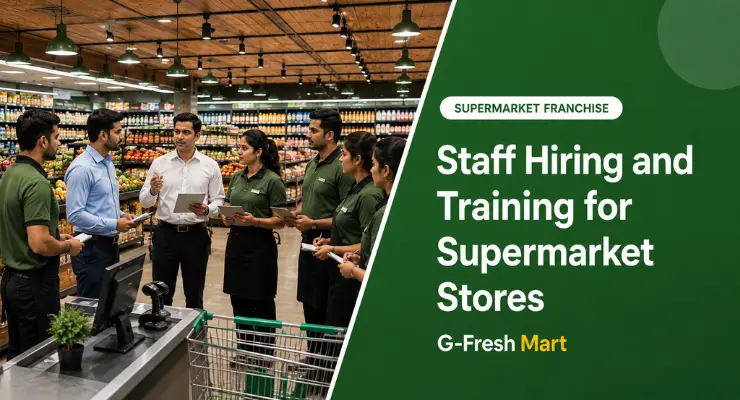
- Staff hiring and training: Confirm whether the franchisor helps recruit staff or only trains people you’ve already hired. G-Fresh Mart provides hiring assistance plus lifetime billing software training, which matters considerably when you need to replace staff two years into operation.
- Accounting support: GST filing and bookkeeping are unfamiliar territory for many first-time owners. G-Fresh Mart provides free accounting support for the first 3 months specifically to ease this transition, covering GST returns, input tax credit reconciliation, and bank reconciliation.
- Ongoing field visits: One-time onboarding is not the same as ongoing support. Ask how often the franchisor’s operations team visits or checks in after opening, and what specifically they review during those visits.
- Marketing assistance: Distinguish between brand-level marketing (national advertising that builds awareness generally) and store-level marketing support (help with your specific grand opening, local promotions, and digital presence). Both matter, but store-level support has a more direct impact on your specific location’s footfall.
Questions to Ask Before Signing Any Franchise Agreement
Beyond the support categories above, six specific questions will tell you more about a franchisor’s reliability than their marketing materials ever will:
What is the exact territory radius of my exclusivity zone, and is it written into the agreement? What is the royalty rate and structure after any free period ends?
What are the termination and exit conditions, and what happens to my security deposit if I exit early? What are my renewal rights and the renewal fee at the end of the agreement term?
Can I speak directly with three existing franchise owners of my choosing, not ones selected by the franchisor? And finally, what specifically happens if my store underperforms in the first six months – is there a defined support escalation process, or am I on my own?
What Determines Whether a Grocery Franchise Store Is Profitable?
Two stores under the identical franchise brand can have completely different outcomes. The franchise model controls supply chain and systems – it does not control these four variables, which sit entirely with the franchise owner.
Location Quality
A Mini Mart format needs at least 2,000 households within a 1.5 km radius to sustain consistent daily revenue. No brand recognition compensates for a location with insufficient catchment population.
Beyond raw household count, the income profile of the catchment area matters too – a location surrounded by households with consistent dual incomes will sustain a higher average basket size than one in an area with seasonal or irregular income patterns, even at identical population density.
Owner Involvement in the First 6 Months
Stores where the owner is present daily during the early months consistently outperform absentee-owned stores. This is the period when staff habits, customer relationships, and operational discipline get established.
An owner who is physically present catches small problems – a consistently understocked shelf, a cashier who is slow at peak hours, a supplier delivery that is frequently late – before they become expensive habits.
By Month 7 or 8, a well-run store with trained staff can often operate with 2-3 hours of daily owner oversight rather than full-time presence, but that transition only works if the foundation was built correctly in the first place.
Inventory Discipline
Dead stock and expired goods quietly erode margin every month. A store that reviews slow-moving SKUs weekly and rotates stock on a strict FIFO (first in, first out) basis protects its margin far more effectively than one that reorders on autopilot.
As a practical benchmark, any product with zero sales movement in 30 days should either be discounted to clear or removed from future reorders entirely – letting it sit on the shelf ties up capital that could be working in faster-moving categories.
Local Marketing Consistency
A WhatsApp broadcast list of regular customers, a claimed and active Google Business Profile, and consistent festival promotions cost close to nothing but compound significantly over 12 months. Stores that skip this step rely entirely on passive footfall.
A WhatsApp list of even 300-500 regular customers, contacted with weekly offers, typically drives a measurable increase in repeat visit frequency within the first quarter of consistent use – and unlike paid advertising, the cost is effectively zero beyond the time it takes to send the message.
Staff Quality and Retention
High staff turnover is one of the most underestimated profit drains in grocery retail. Every time a cashier or floor staff member leaves, there is a training gap during which billing errors, customer service lapses, and inventory mistakes become more likely.
Stores that pay slightly above the local market rate and offer a small performance-linked monthly bonus – even ₹500 to ₹1,500 tied to specific targets – typically see meaningfully lower turnover than stores that pay strictly minimum wage with no incentive structure.
What Risks Should You Plan for Before Signing a Franchise Agreement?
No franchise model eliminates risk entirely, and any franchisor who claims otherwise should be treated with caution.
The risks below are the ones that actually determine outcomes in practice, based on common patterns across Indian grocery franchise operations.
| Risk | Why It Happens | How to Reduce It |
| Wrong location chosen | Site survey skipped or based on optimism rather than data | Insist on a formal site survey; independently verify household count and footfall before signing |
| Underfunded working capital | Investors budget only for franchise fee and stock, not 3 months of operating costs | Add a minimum 10% contingency buffer to every cost estimate before committing capital |
| High staff turnover | Below-market pay with no incentive structure | Pay competitively for the local market and add a small performance bonus from Day 1 |
| Slow break-even due to passive marketing | No WhatsApp list, no Google Business Profile, no local promotion | Build a customer contact list and claim your digital listings before opening day, not after |
| Royalty payment shock after the free period | Owner did not plan cash flow for the royalty stage | Read the full royalty schedule in the agreement and build it into your Month 7+ financial projections |
How Long Does It Take to Open a Grocery Store Franchise?
From first inquiry to opening day, the typical timeline runs 60-75 days. This breaks into two phases: pre-agreement (site survey, documentation, verification – roughly 15-20 days) and setup (interior fit-out, stock, staff training, launch – 45 days with G-Fresh Mart’s structured process).
Independent grocery stores typically take 3-6 months to open because every step – finding suppliers, designing the layout, sourcing billing software, hiring without a training framework – has to be solved from scratch rather than following an existing system.
| Phase | Typical Duration | What Happens |
| Inquiry & Consultation | 2-4 days | Initial contact, discussion of investment, format, and target location |
| Site Survey | 5-7 days | Franchisor’s field team assesses your proposed location |
| Documentation & Agreement | 7-10 days | Verification, franchise agreement signing, license applications begin |
| Interior Fit-Out | 18-25 days | Branding, shelving, signage, billing software installation |
| Stock & Staff Training | 10-15 days (overlapping with fit-out) | Initial inventory delivery, staff hiring and training |
| Grand Opening | 1-2 days | Store launch with marketing support |
Check out this: Supermarket Franchise Cost in India: The Complete 2026 Breakdown
Evaluate Your Grocery Store Franchise Options
A grocery store franchise removes the two hardest parts of starting a retail business – supply chain access and operational design – in exchange for a franchise fee and ongoing royalty.
Whether that trade-off is worth it depends on your capital, your location, and how much support the specific franchisor actually delivers once you’ve signed.
G-Fresh Mart’s franchise model starts at ₹14 lakh for a Mini Mart Format, includes a 45-day setup guarantee, and charges zero royalty for the first 6 months.
You can see how G-Fresh Mart’s store network has grown across 22+ states before deciding. To see what your specific investment would look like, calculate your franchise cost or apply directly at G-Fresh Mart.
Frequently Asked Questions
How much does a grocery store franchise cost in India?
A grocery store franchise in India costs between ₹14 lakh and ₹90 lakh depending on format. A Mini Mart (500-1,000 sq ft) starts around ₹14-25 lakh including franchise fee, billing software, fit-out, and initial stock. Use a calculator like the one at gfreshmart.com/calculator for a format-specific estimate.
Is a grocery franchise a good investment for a first-time business owner?
Yes, for most first-time owners, a grocery franchise carries lower risk than an independent store because it provides supply chain access, tested operational systems, and brand recognition from Day 1. Retail experience is generally not required, since the franchisor provides training and support throughout setup and operation.
How long does it take to open a grocery store franchise?
Most grocery franchises open within 60-75 days from first inquiry to opening day. This includes site survey and documentation (15-20 days) and store setup including fit-out, stock, and staff training (around 45 days with a structured franchisor process).
What is the difference between a grocery franchise and an independent grocery store?
A grocery franchise gives you brand recognition, negotiated supplier pricing, and a tested operational system in exchange for a franchise fee and ongoing royalty. An independent store gives you full control and no royalty, but requires building supplier relationships, brand trust, and operational systems from scratch – typically taking longer to reach profitability.
What is the difference between FOFO and FOCO grocery franchise models?
In a FOFO (Franchise Owned, Franchise Operated) model, you own the store and run it day to day, keeping all profit after fees. In a FOCO (Franchise Owned, Company Operated) model, the franchisor manages daily operations while you provide capital, similar to a passive investment. G-Fresh Mart operates exclusively on the FOFO model, meaning franchise owners actively run their own stores.
Do I need prior retail experience to open a grocery store franchise?
No. Most grocery franchise brands, including G-Fresh Mart, are designed for first-time business owners with no retail background. Training typically covers billing software, inventory management, staff handling, and customer service. The franchisor’s existing systems replace the need for prior hands-on retail experience.